
Executive Summary / Key Takeaways
Comprehensive technical guide to building headless Shopify Plus platforms. Learn how edge caching, optimistic UI, and custom APIs deliver sub-second commerce experiences.
- Decouples customer presentation from Shopify Plus backend via GraphQL Storefront APIs.
- Eliminates third-party app script waterfalls that degrade mobile conversion rates.
- Enables sub-second edge page transitions while maintaining PCI-DSS Level 1 checkout compliance.
For high-volume merchants, Shopify's standard monolithic Liquid templating engine eventually hits an immovable ceiling. Third-party app bloat, render-blocking scripts, rigid URL structures, and cross-origin checkout hops erode customer conversion rates on mobile devices.
Going Headless on Shopify Plus decouples the customer-facing frontend presentation layer from Shopify's enterprise commerce backend.
In this comprehensive technical guide, we examine the architecture, data fetching patterns, and performance optimizations used to build decoupled headless storefronts with sub-second page transitions.
1. Why Ambitious Brands Decouple Shopify
When evaluating headless architecture, engineering teams and e-commerce directors must weigh tangible business metrics against architectural complexity:
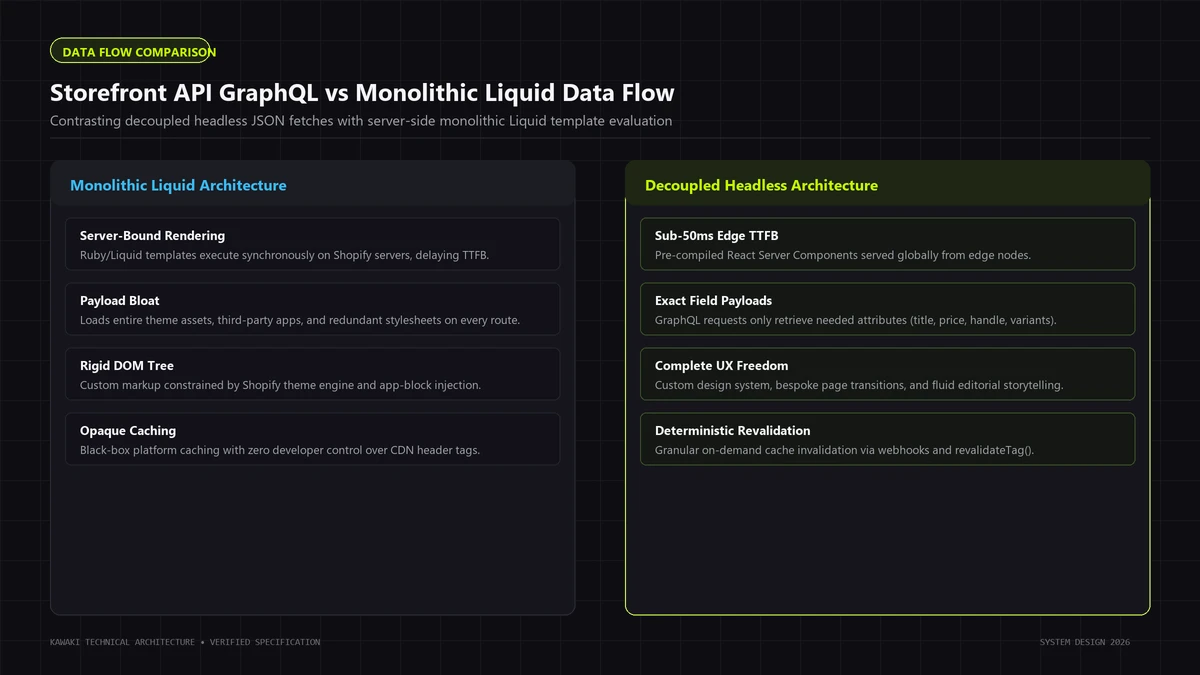
- Sub-Second Page Transitions: Liquid renders server-side on Shopify's centralized servers for every page request. Decoupled frontends (built on Next.js or Shopify Hydrogen) leverage edge computing (Cloudflare Workers, Vercel Edge) to serve catalog pages in under 80 milliseconds.
- Total Design and UX Freedom: You are no longer constrained by Liquid's DOM structure or rigid theme editor settings. Build custom 3D configurators, non-standard layout grids, and bespoke editorial checkout flows.
- Multi-Market and Localization Scale: Serve distinct currencies, localized languages, and personalized inventory catalogs from a single unified codebase.
- Clean Codebase Immune to App Rot: Third-party Shopify apps inject unminified CSS and tracking scripts into Liquid theme files. In a headless setup, integrations occur strictly via server-side APIs or isolated microservices, keeping the client bundle lean.
2. The Modern Headless Shopify Stack
The 2026 enterprise headless stack consists of four decoupled layers:
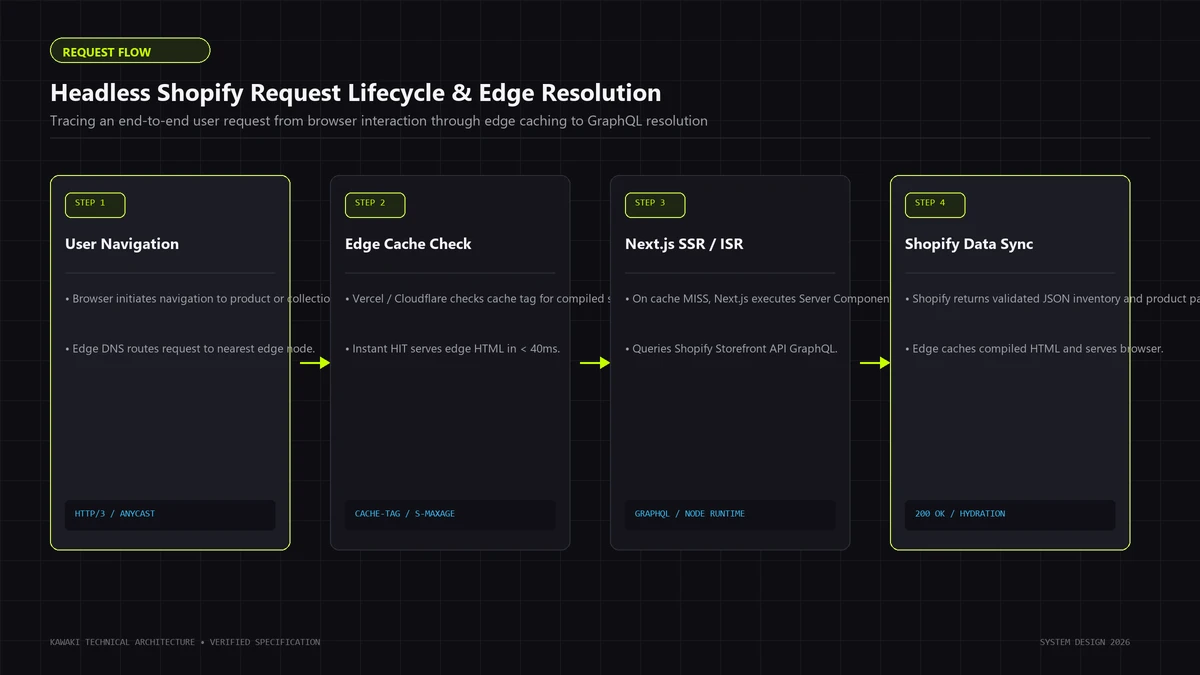
- Presentation Layer: Next.js App Router or Shopify Hydrogen with React Server Components.
- Edge Routing & Caching: Cloudflare Workers or Vercel Edge delivering stale-while-revalidate caching and Geo-IP currency routing.
- Commerce Engine: Shopify Storefront GraphQL API (v2026-01+) powering products, collections, inventory, and cart mutations.
- Editorial CMS: Decoupled CMS (Sanity, Contentful, or bespoke markdown engine) powering campaigns, lookbooks, and brand storytelling.
3. Engineering Optimistic Cart Mutations
The cart is where conversion rate optimization (CRO) is won or lost. In traditional Shopify stores, clicking 'Add to Cart' triggers a blocking network request, displays a loading spinner, and refreshes the cart drawer after a 400–800ms delay.
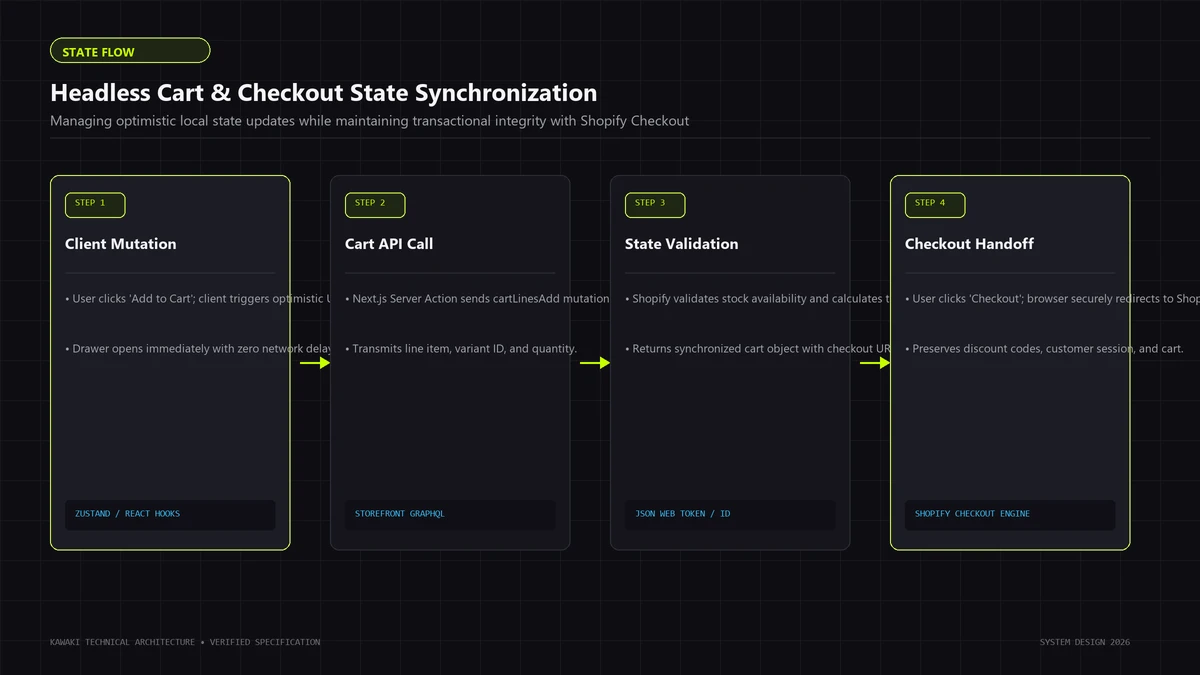
In a high-velocity headless architecture, we implement Optimistic Cart State:
- Instant UI Response: When a user clicks 'Add to Bag', the local client state updates instantly (0ms delay), incrementing the badge counter and opening the slide-over drawer with spring physics.
- Background Mutation Pipeline: A background GraphQL mutation is dispatched to Shopify's cartLinesAdd endpoint.
- Reconciliation & Error Recovery: If the network request succeeds, the local cart merges with Shopify's returned cart token. If an out-of-stock condition occurs, the UI seamlessly rolls back with an elegant notification toast.
This pattern eliminates perceived latency and keeps mobile shoppers in an uninterrupted buying flow.
4. Edge Caching & Cache Invalidation Strategy
The primary challenge of headless e-commerce is ensuring product inventory, pricing, and availability remain strictly synchronized without sacrificing edge caching speed.
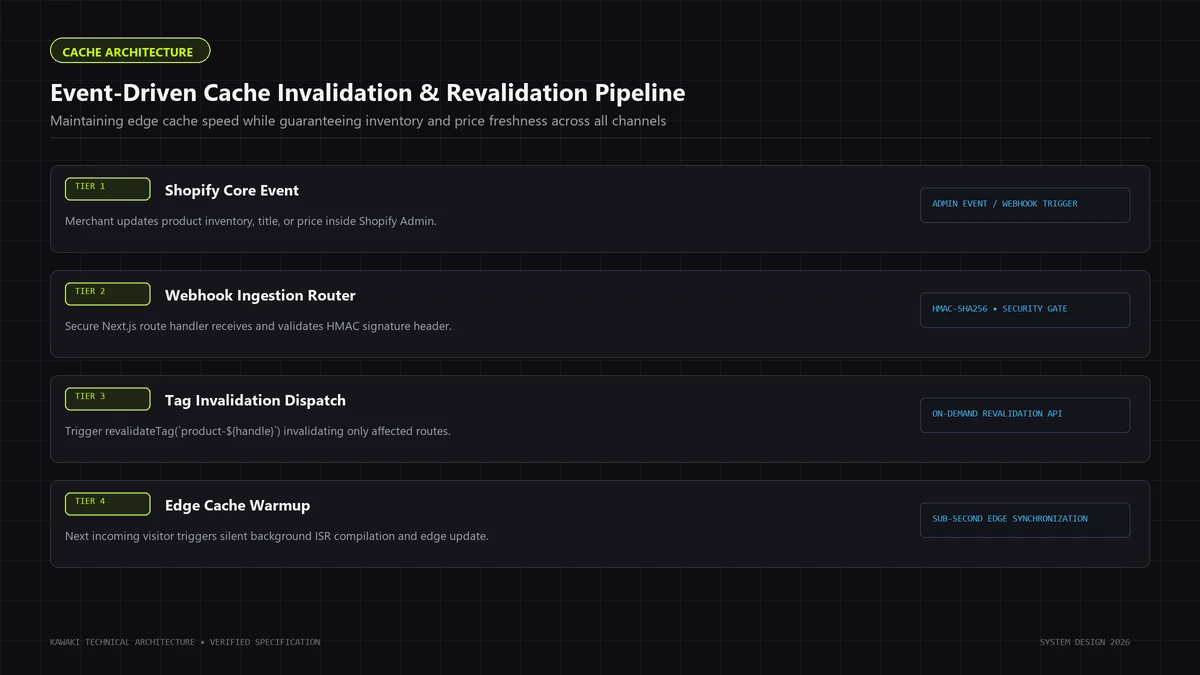
Stale-While-Revalidate (SWR) with Webhook Invalidation
- Catalog Pages (Collections & Products): Cached globally at the CDN edge with an SWR policy (s-maxage=3600, stale-while-revalidate=86400).
- Inventory Webhooks: Shopify inventory_levels/update and products/update webhooks trigger instant, surgical edge cache purges for the specific product slug via on-demand revalidation.
- Dynamic Pricing & Stock Checks: On the Product Detail Page (PDP), static product copy and imagery render instantly from the edge cache, while real-time variant stock is hydrated via a lightweight client-side micro-query.
5. Architectural Blueprint: Decoupled Commerce Architecture
In our decoupled commerce reference design (modeled for high-velocity storefronts):
- Core Web Vitals Target: Decoupled edge delivery targeting LCP under 1.0 second.
- Layout Stability: Pre-computed responsive aspect ratios targeting zero Cumulative Layout Shift (CLS).
- Optimistic Interactions: Client-side cart mutations designed for instant feedback.
- Edge Routing: Dynamic routing and inventory synchronization without origin roundtrips.
Explore the architectural blueprint: Acme E-Commerce Architecture Concept.
6. Frequently Asked Questions
Does going headless break standard Shopify apps?
Front-end widget apps (such as basic review stars or pop-up countdowns) do not automatically inject into a custom headless frontend. Instead, you integrate review systems (such as Yotpo, Okendo, or Stamped) via their official REST/GraphQL APIs, resulting in faster load times and complete styling control. Back-office apps (shipping, ERP, inventory, taxes) function completely undisturbed.
How does checkout work in headless Shopify?
Checkout operates natively through Shopify's PCI-compliant, one-page checkout. When the customer is ready to transact, the frontend calls the Storefront API to generate a verified checkout URL and redirects the buyer seamlessly, preserving all discounts, gift cards, and Shop Pay preferences.
What is the typical scope for a custom headless build?
Headless build scope varies based on catalog complexity, third-party integrations, and performance requirements—from focused storefront migrations to multi-brand international deployments. Explore our Services or Contact us to discuss technical requirements.
Ready to Elevate Your Commerce Infrastructure?
If your current Shopify store is constrained by template limitations or sluggish mobile load times, let's talk engineering. Schedule an architectural briefing with our technical partners.
Need Help Engineering Your Web Platform or AI Systems?
From high-performance Next.js architectures to headless Shopify storefronts, custom AI automations, and enterprise WordPress security recovery, Kawaki Studios designs resilient digital infrastructure built to scale.