Executive Summary / Key Takeaways
A practical pre-hire preparation guide for founders and businesses. Learn how to define project scope, technical requirements, budget models, and vetting criteria.
- Defines the four essential pre-hire pillars: Business Objectives, Technical Scope, Design Readiness, and IP Governance.
- Explains how ambiguity triggers agency risk contingencies and expensive change-order cycles.
- Provides a comprehensive pre-hire RFP scoping checklist and 5 technical vetting questions.
Hiring a web development agency is one of the highest-leverage investments a company can make—and one of the most frequently mismanaged. Industry data consistently indicates that over 65% of custom web and software projects experience significant budget overruns, delayed release dates, or contentious scope disputes.
The root cause of these failures is rarely poor engineering talent. In the overwhelming majority of cases, projects derail because of ambiguity during the pre-hire phase.
When a client approaches an agency with a two-page brief stating "we need a fast, modern website like Stripe or Airbnb," the agency is forced to bid on assumptions. Two agencies can interpret that sentence in wildly divergent ways: one proposes a pre-bought WordPress theme with 40 third-party plugins for $4,000, while another scopes a bespoke, headless Next.js web application with a design system, automated CI/CD, and custom API pipelines for $40,000. Both technically answered the brief, but only one matches the client's actual long-term technical and commercial requirements.
The success of an agency engagement is decided before the contract is signed. The more clearly you define your business outcomes, technical boundaries, content assets, and decision criteria upfront, the faster an agency can deliver—and the less you will pay in unexpected change-orders.
Whether you are a founder building a new digital flagship, an ecommerce brand migrating to headless Shopify, or a business leader planning a custom web platform, this guide outlines the exact preparation framework required before hiring a web development agency.
1. The Cost of Ambiguity: Why Projects Stall
In software development, there is an unwritten law: Ambiguity is an expensive loan that compounds interest daily.
When project requirements are vague:
- Agencies Build in Risk Contingencies: Honest engineering agencies add a 25% to 50% buffer to fixed-price quotes to protect themselves against undefined scope. You pay for their uncertainty.
- Low-Tier Agencies Underbid to Lock You In: Disreputable agencies deliberately bid low on vague scopes, knowing they can exploit missing specifications later with extortionate "change-order" fees once your deposit is paid and your launch deadline approaches.
- Architecture Mismatches Occur: An agency might build your platform on a restrictive no-code builder or rigid monolith when your actual three-year roadmap required multi-tenant databases, custom authentication, or sub-second Core Web Vitals performance.
Preparation does not require you to write production code or create comprehensive database schemas yourself. It requires you to articulate your business goals, identify functional must-haves, assemble your brand assets, and establish clear governance rules.
2. The 4 Pre-Hire Preparation Pillars
Before scheduling discovery calls with prospective agencies, organize your project requirements into four distinct pillars:
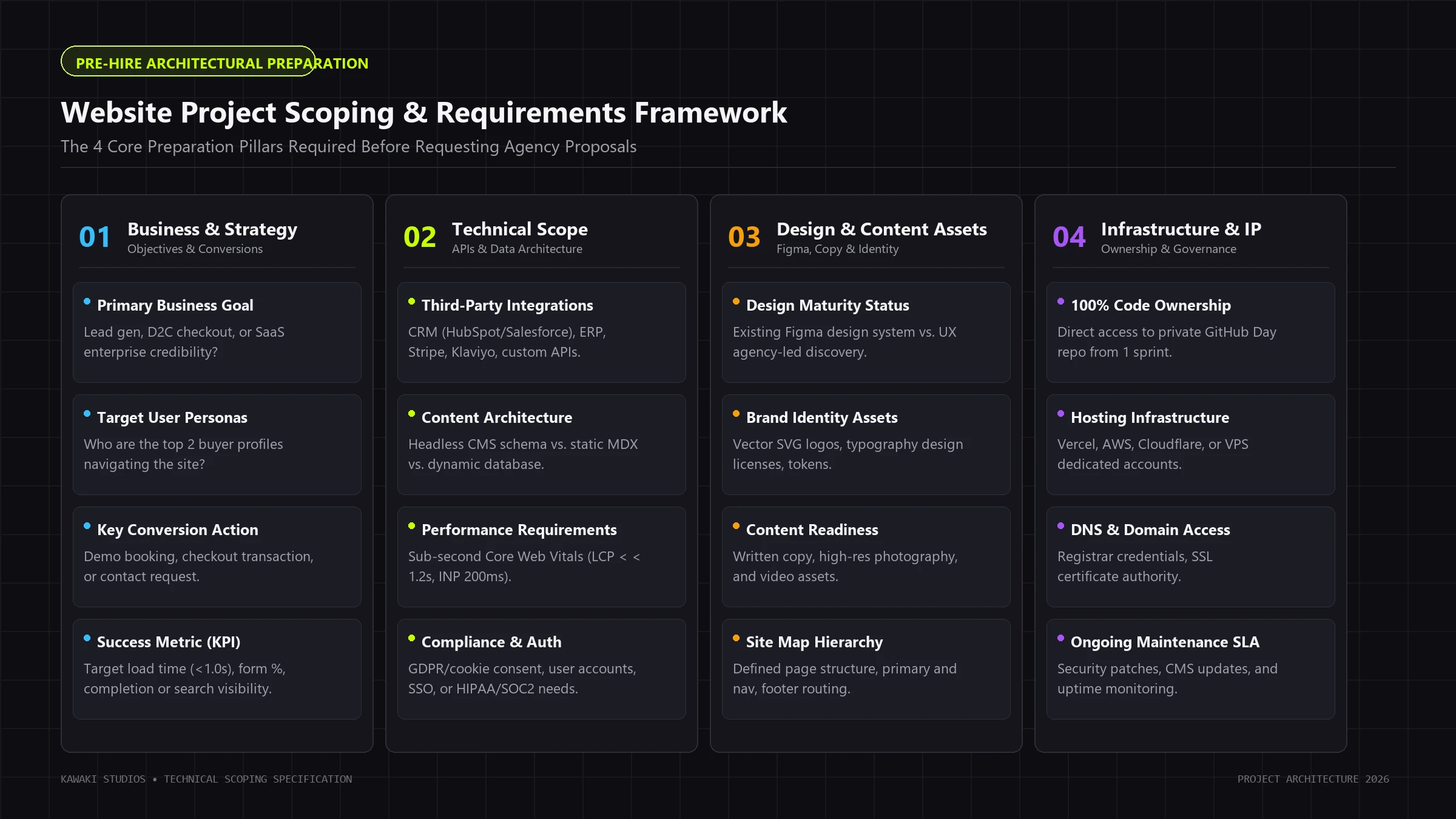
Pillar 1: Business Objectives & User Conversion Journeys
Agencies need to know why the website exists and how you measure return on investment (ROI). Avoid generic goals like "increase brand awareness." Define concrete commercial outcomes:
- Primary Business Metric: Is the site built to generate qualified enterprise demo bookings, drive high-velocity D2C transactions, or provide investor credibility for an upcoming funding round?
- Target Personas: Who are the two primary user types visiting the platform? (e.g., A busy healthcare director evaluating compliance vs. a patient seeking immediate booking).
- Primary Conversion Paths: Exactly what sequence of actions should a visitor take from landing on the homepage to completing a conversion?
- Performance Key Performance Indicators (KPIs): Target load speed (<1.2s Largest Contentful Paint), form completion rates, organic search visibility, or mobile conversion lift.
Pillar 2: Technical Scope, APIs & Data Architecture
This is where scope creep lives. Define what the website must do, beyond how it looks:
- Third-Party Integrations: List every external software system the website must communicate with:
- CRM & Lead Routing: HubSpot, Salesforce, Pipedrive.
- Payment Gateways: Stripe, PayPal, Razorpay.
- Email & Marketing Automation: Klaviyo, Mailchimp, Customer.io.
- ERP & Inventory Management: NetSuite, SAP, Katana.
- Analytics & Telemetry: Google Analytics 4, PostHog, Mixpanel, Microsoft Clarity.
- Content Management System (CMS) Expectations: Who will update content post-launch? Do non-technical marketing team members need visual block editing, or do you prefer a structured headless CMS (Sanity, Strapi, Contentful) or Markdown-based repository workflows?
- User Authentication & Gated Portals: Do customers need user accounts, role-based access control (RBAC), subscription gating, or single sign-on (SSO)?
- Compliance & Security Requirements: Must the site comply with GDPR, CCPA, HIPAA, SOC 2, or PCI-DSS Level 1 standards?
Pillar 3: Design Maturity & Content Readiness
One of the most frequent causes of project delays is content bottlenecks. An agency cannot build a website around non-existent photography and placeholder text without severe redesign costs later:
- Design Status:
- Scenario A: You already have a completed, componentized Figma design system that needs front-end implementation.
- Scenario B: You have wireframes and brand guidelines, but need the agency to lead full UI/UX design.
- Scenario C: You are starting from scratch and require brand discovery, typography selection, and art direction.
- Brand Assets Inventory: Ensure you have vector SVG logos, primary and secondary color palettes, licensed web fonts (with webfont files ready), and brand voice guidelines.
- Content Readiness: Who is writing the page copy? Do you have high-resolution photography, product renders, case study data, and video assets ready, or must the agency budget for content production and technical writing?
Pillar 4: Infrastructure, DNS & IP Ownership
Establish technical governance and administrative ownership before granting access:
- Domain & DNS Control: Ensure your team owns the domain registrar account (Cloudflare, Namecheap, GoDaddy). Never allow an agency to register your primary domain under their personal account.
- Hosting Preferences: Do you have existing cloud infrastructure (AWS, Google Cloud, Vercel, Cloudflare Pages), or do you need the agency to recommend and provision an architecture?
- Code Repository & Intellectual Property (IP): Require that all custom code is committed directly to your organization’s private GitHub or GitLab repository from Sprint 1.
3. How to Draft a Lightweight Project Brief (RFP)
You do not need a 60-page formal Request for Proposal (RFP) to get accurate estimates. In fact, most top-tier engineering studios prefer a focused 4-to-6 page brief that clearly articulates the core requirements without bureaucratic padding.
Recommended Project Brief Structure:
1. Company Background & Mission
   - Who you are, what you sell, and your positioning in the market.

2. Problem Statement & Project Catalyst
   - Why are you building or rebuilding now?
   - What are the limitations or failures of your current website?

3. Target Audience & Core User Stories
   - "As a [buyer type], I want to [take an action] so that I can [achieve an outcome]."

4. Scope of Work (SOW) & Page Inventory
   - Estimated page count (e.g., Homepage, 4 Service Hubs, 15 Category Pages, Blog Engine, Contact).
   - Core interactive features (e.g., pricing calculator, interactive product visualizer, multi-step booking form).

5. Technical Requirements & Integrations
   - Preferred tech stack (or openness to agency recommendation).
   - Explicit list of mandatory third-party APIs.
   - Non-negotiable technical requirements (e.g., sub-second mobile page loads, zero layout shift).

6. Non-Goals (What This Project Is NOT)
   - Defining what is explicitly out-of-scope prevents misunderstandings.
   - Example: "Phase 1 will NOT include a native mobile app or customer login portal."

7. Budget Range & Timeline Expectations
   - Realistic budget window and hard deadline constraints (e.g., product launch, funding announcement).
The Power of the "Non-Goals" Section
Stating what you do not want built is just as critical as stating what you do want. If an agency knows that user account creation or multi-language localization is deferred to Phase 2, they will not waste time engineering unnecessary architectural overhead into your initial milestone.
4. Contract Models: Fixed-Price vs. Sprint-Based
Understanding how agencies price their work is essential for protecting your budget and aligning incentives:
| Dimension | Fixed-Price Contract | Sprint-Based / Milestone Model |
|---|---|---|
| Best Suited For | Small, rigidly defined marketing sites (<10 pages) with finalized designs. | Complex web applications, high-growth startups, and custom headless platforms. |
| Scope Flexibility | Rigid. Any change to the original document requires a formal, billable change-order. | High. Scope can be reprioritized at the start of each two-week sprint backlog. |
| Agency Incentive | Incentive is to finish as fast as possible with the minimum allowable effort. | Incentive is to deliver high-velocity, clean code and maintain long-term alignment. |
| Client Risk | Lower financial uncertainty upfront, but high risk of hidden quality compromises. | Requires active client participation and transparent weekly milestone reviews. |
| Pricing Buffer | Contains a 20–40% contingency padding to hedge agency risk. | You pay for actual engineering velocity and verified milestone deliverables. |
When Fixed-Price Backfires
Fixed-price contracts appear safe because they promise certainty. However, in custom software, unknown technical variables inevitably emerge—an undocumented legacy API, a third-party webhook failure, or a necessary pivot in user onboarding. In a fixed-price model, the agency's legal obligation is to fulfill the contract, not to solve the newly discovered business problem.
For ambitious custom platforms, a hybrid milestone model—combining a fixed-price discovery and design phase followed by sprint-based development against verified deliverables—consistently produces superior software.
5. Technical Questions to Vet an Agency Candidate
When interviewing prospective web development agencies, bypass generic sales pitches and portfolio slideshows. Ask specific technical and operational questions that immediately separate elite engineering teams from template assemblers:
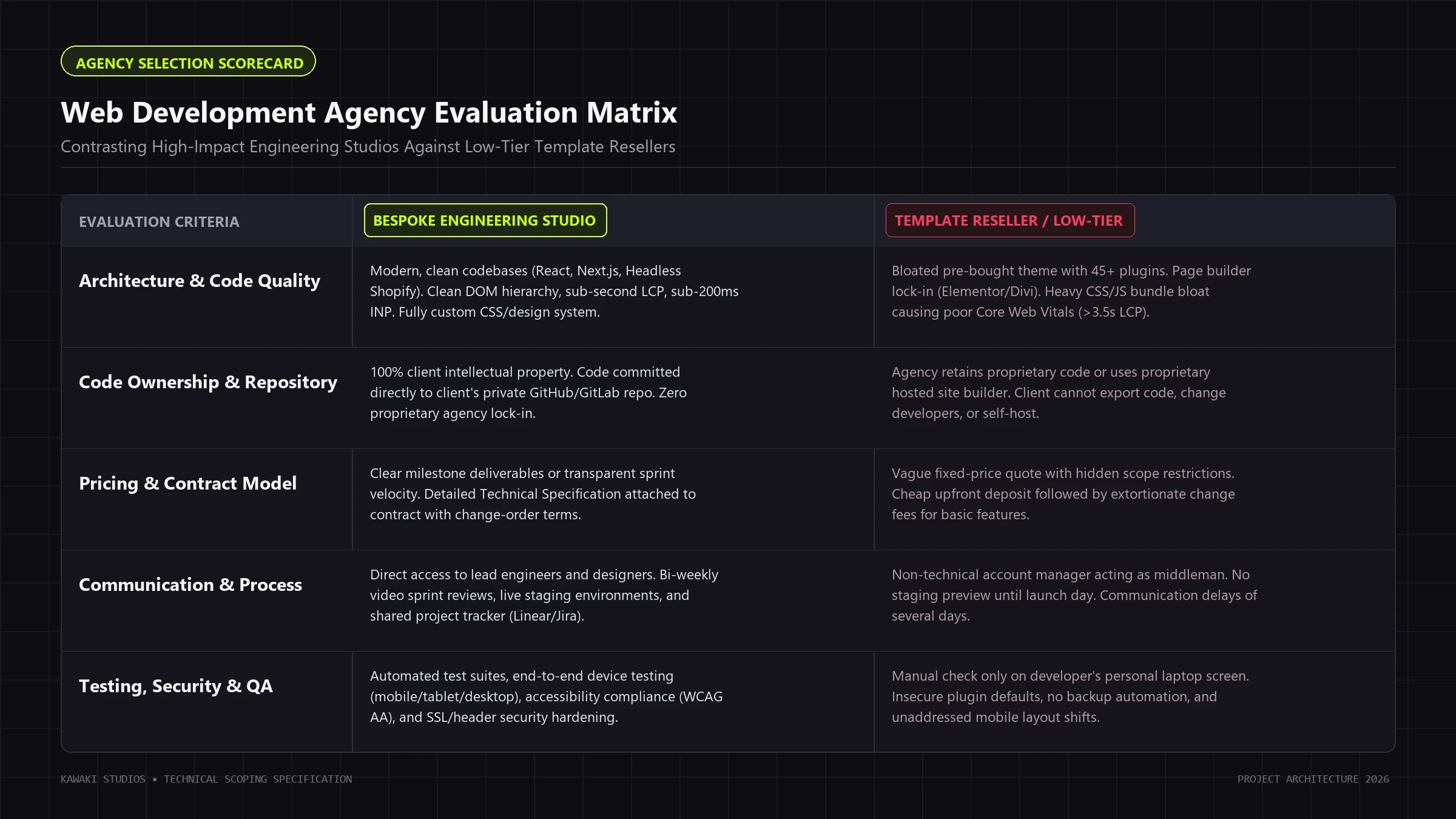
1. Code Ownership and Repository Access
"Who holds the intellectual property, and will our team have administrative access to the GitHub/GitLab repository from the first day of development?"
- The Right Answer: "You own 100% of the code, designs, and assets. We commit directly to your private GitHub organization, and your engineers can inspect the commit history anytime."
- The Red Flag: "We host the code on our internal servers during development and hand over a ZIP file upon final payment," or "The site is built on our proprietary agency CMS."
2. Architecture and Foundation
"Will this project be custom-engineered using modern frameworks, or built on a pre-bought commercial theme or page builder?"
- The Right Answer: The agency explains their architectural rationale based on your scale: e.g., a modern Next.js or React architecture for sub-second performance, or clean custom Shopify Liquid/Theme code without bloated page builders.
- The Red Flag: "We use an all-in-one theme with Elementor/WPBakery because it's fast to set up." (This results in heavy DOM bloat, 40+ database plugins, and terrible Core Web Vitals).
3. Core Web Vitals and Performance Commitments
"What contractual performance standards do you engineer for regarding Largest Contentful Paint (LCP) and Interaction to Next Paint (INP)?"
- The Right Answer: The agency discusses technical optimization strategies: static site generation (SSG), edge caching, server-side asset optimization, responsive WebP/AVIF images, and minimal JavaScript payloads aimed at sub-1.2s mobile LCP.
- The Red Flag: "We install an SEO plugin and a caching plugin at launch to speed things up." (Plugins cannot fix foundational architectural bloat).
4. The Engineering Team Structure
"Who will actually write our code and design our interfaces—in-house senior engineers, or outsourced white-label subcontractors?"
- The Right Answer: You are introduced to the lead engineer or technical director who will oversee your repository. Communication happens directly with the builders via Slack or shared project management tools.
- The Red Flag: You only ever speak to a sales representative or account manager who cannot answer basic technical questions without "checking with the offshore dev team."
5. Staging Environments and QA Workflow
"How do we review progress before launch, and what is your quality assurance protocol across mobile devices and browsers?"
- The Right Answer: Automated preview URLs generated on every Git pull request (e.g., Vercel or Netlify preview deployments), allowing your team to test functional features on staging before merging to production.
- The Red Flag: "We build the site live on your domain with a 'Coming Soon' maintenance plugin," or "We show you screenshots until launch day."
6. Red Flags to Watch Out For During Proposals
Be cautious if you observe any of the following patterns during the discovery and proposal phase:
- The Instant Quote: An agency gives you a firm cost and timeline within 10 minutes of conversation without asking detailed questions about your API integrations, database models, or content readiness.
- Proprietary Vendor Lock-In: The agency insists on hosting your website on their private server infrastructure, preventing you from migrating to another provider or hiring internal developers in the future.
- No Verifiable Case Studies: The agency shows beautiful mockups on Dribbble or Behance, but cannot provide live, functional URLs of real client websites they built and maintain.
- Vague Payment Milestones: Demanding 50% upfront with the remaining 50% tied vaguely to "launch," rather than tied to verified, testable functional milestones (e.g., Milestone 1: Approved Design System, Milestone 2: Functional Staging MVP, Milestone 3: Final QA & Production Cutover).
- Ignoring Post-Launch Realities: The agency has no plan or protocol for security patching, dependency updates, uptime monitoring, or post-launch warranty support.
7. Real-World Scoping in Practice: Two Case Studies
At Kawaki Studios, our engineering team frequently guides clients through pre-hire architectural discovery. Two contrasting project examples demonstrate why pre-hire clarity matters:
Case Study 1: Architectural Minimalism for Kala Design Co.
When architecture firm Kala Design Co. approached Kawaki Studios for a digital monograph, their goal was clear: create an unhurried, visually immersive digital archive that reflected the minimalism and craftsmanship of their physical architectural projects.
- What Was Prepared: A curated inventory of high-resolution architectural photography, defined typography requirements, and an explicit refusal of generic marketing tropes or heavy animations.
- The Architectural Outcome: A bespoke, lightweight digital flagship engineered with clean semantic HTML, bespoke CSS layout rails, and instant image delivery—achieving sub-0.8s LCP and editorial elegance without bloated CMS frameworks.
Case Study 2: High-Velocity Headless Commerce for BAZZARO
Luxury direct-to-consumer brand BAZZARO needed a high-performance ecommerce platform capable of handling rapid catalog browsing and sub-second checkout transitions.
- What Was Prepared: Detailed technical mappings of their Shopify product catalog, third-party ERP inventory sync requirements, and strict Core Web Vitals conversion benchmarks.
- The Architectural Outcome: A headless Shopify storefront utilizing edge caching and optimized API boundaries, delivering instant product discovery and a seamless checkout experience.
8. The Comprehensive Pre-Hire Client Checklist
Use this checklist to ensure your internal team is 100% prepared before issuing an RFP or scheduling agency interviews:
| Category | Preparation Item | Status |
|---|---|---|
| Strategy | Defined primary business goal and conversion metric | [ ] |
| Strategy | Documented top 2 target user personas | [ ] |
| Scope | Complete list of required pages and sitemap hierarchy | [ ] |
| Scope | Documented must-have interactive features vs. Phase 2 non-goals | [ ] |
| Technical | Complete inventory of third-party software and API integrations | [ ] |
| Technical | Defined CMS and content management expectations | [ ] |
| Technical | Non-negotiable Core Web Vitals and accessibility benchmarks | [ ] |
| Assets | Vector SVG logos, typography licenses, and brand color palette | [ ] |
| Assets | Content readiness plan (who writes copy; high-res media inventory) | [ ] |
| Governance | Direct administrative ownership of domain registrar & DNS | [ ] |
| Governance | Dedicated private GitHub/GitLab organization for code ownership | [ ] |
| Governance | Realistic budget range and hard deadline milestones identified | [ ] |
9. Frequently Asked Questions (FAQ)
How much should a custom website development project cost?
Costs vary drastically depending on architectural complexity. A simple, bespoke marketing website engineered with clean static code typically ranges from $5,000 to $15,000. Complex web applications, headless ecommerce platforms, or custom SaaS systems involving dynamic databases, user authentication, and multi-API integrations typically range from $20,000 to $60,000+. Be wary of quotes substantially below industry norms; they almost universally rely on bloated, pre-made templates with high technical debt.
How long does a typical web development project take?
A focused custom marketing website built by a dedicated studio typically takes 4 to 8 weeks from kickoff to production launch. Complex web platforms or headless ecommerce rebuilds typically take 8 to 16 weeks, structured across discovery, UI/UX design, front-end engineering, API integration, and comprehensive staging QA.
What is a "Discovery Phase," and should I pay for one?
Yes. For complex projects, a paid Discovery Phase (typically 1 to 2 weeks) is a sign of a mature engineering studio. During discovery, the agency audits your data, diagrams your system architecture, defines API schemas, and produces a definitive Technical Specification Document. You can take that specification to any agency to build—it eliminates risk for both parties.
Can an agency start development before design is finished?
In modern agile engineering, development can begin once the global design system (typography, color tokens, layout grids, and core component primitives) is approved. Front-end engineers can scaffold the repository, establish CI/CD pipelines, configure API routing, and build foundational components while detailed page-level UI designs are finalized in parallel.
What happens if we need to change features during the project?
In a milestone or sprint-based contract, scope adjustments are natural. At the start of each sprint, your team and the lead engineer review the backlog. If a new priority emerges, you swap an equivalent feature out of the current sprint or extend the timeline transparently. In a fixed-price contract, changes require a formal written Change Order with adjusted pricing.
10. Next Steps: Plan Your Project Architecture
Preparing for a web development engagement requires upfront effort, but it pays immediate dividends in reduced costs, faster delivery, and a superior end product.
If you are planning a new digital flagship, web application, or ecommerce rebuild, the engineering team at Kawaki Studios can help you review your technical requirements, evaluate architectural options (from headless frameworks to bespoke platforms), and scope a clear milestone roadmap.
Ready to discuss your project? Schedule a technical consultation with Kawaki Studios to review your requirements with our lead engineers.
Need Help Engineering Your Web Platform or AI Systems?
From high-performance Next.js architectures to headless Shopify storefronts, custom AI automations, and enterprise WordPress security recovery, Kawaki Studios designs resilient digital infrastructure built to scale.