Executive Summary / Key Takeaways
Discover what editorial engineering is and why leading digital brands use publication-grade typography, narrative pacing, and sub-second architectures to outpace competitors.
- Editorial engineering bridges publication typography, art direction, and high-performance software architecture.
- Replaces sterile template bloat with intentional narrative pacing, bespoke layouts, and sub-second critical rendering paths.
- Prioritizes human reader immersion alongside flawless Core Web Vitals and search crawler parsing.
In an internet saturated with lookalike SaaS templates, interchangeable Tailwind component libraries, and homogenized ecommerce themes, the web has suffered a profound aesthetic collapse. Every homepage features the same oversized centered badge, the same three-column feature cards, and the same sterile sans-serif font stack.
Editorial Engineering is the antidote.
It is a disciplined intersection of print publication design, journalistic narrative pacing, and mission-critical software engineering. At Kawaki Studios, we define editorial engineering not as aesthetic ornamentation, but as a holistic architecture where design, typography, and performance function as a singular narrative vessel.
1. The Core Definition: Beyond Traditional Frontend Development
Traditional web development treats content as a passive payload injected into pre-fabricated layout containers. Designers create static wireframes in Figma, developers translate them into rigid CSS grids, and copywriters force copy into fixed character limits.
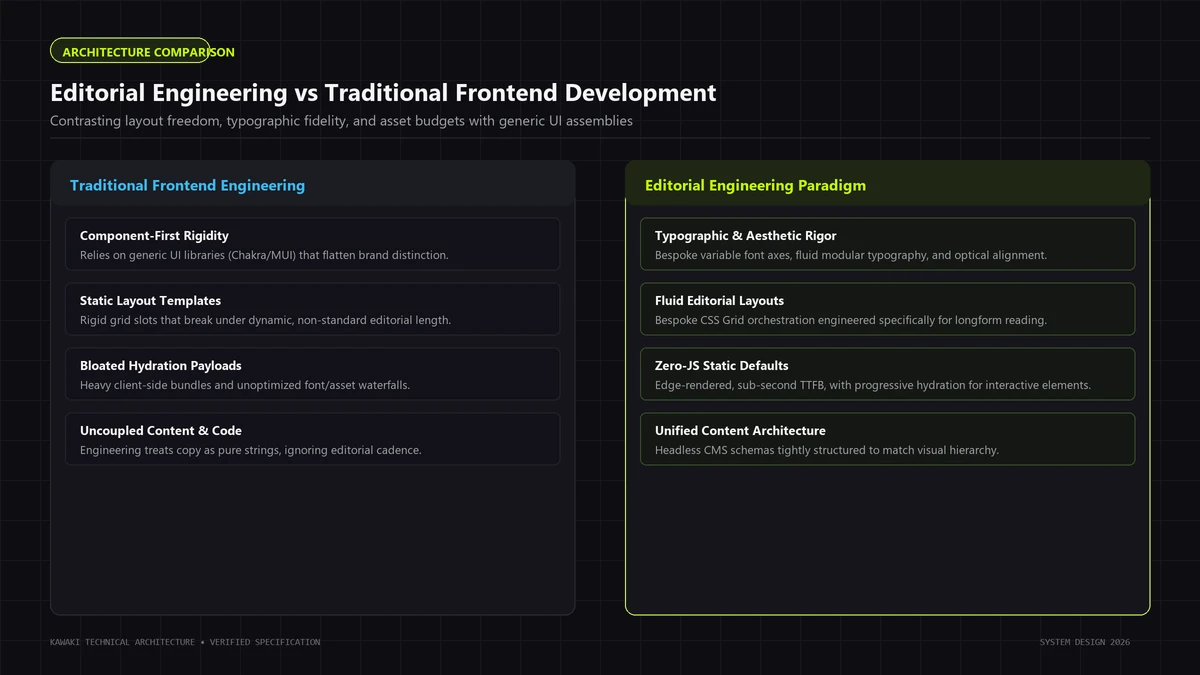
Editorial engineering upends this hierarchy:
- Content Shapes the Architecture: Layouts dynamically adapt to the cadence, rhythm, and emotional tone of the editorial prose.
- Typography is Structural Infrastructure: Rather than defaulting to system UI fonts, typographical pairings (such as high-contrast serifs paired with technical grotesks) guide the visitor's reading velocity.
- Motion Serves as Visual Punctuation: Micro-interactions, kinetic text reveal states, and fluid scroll triggers act as journalistic cues rather than distracting novelties.
- Sub-Second Performance is Non-Negotiable: A narrative cannot command attention if page transitions stutter or assets trigger Cumulative Layout Shifts (CLS).
2. The Three Architectural Pillars of Editorial Engineering
Pillar I: Publication-Grade Typographic Systems
In print journalism—from The New Yorker to Monocle—typography is calibrated with surgical precision. Leading, tracking, optical margins, and measure (line length) are calculated to minimize cognitive fatigue.
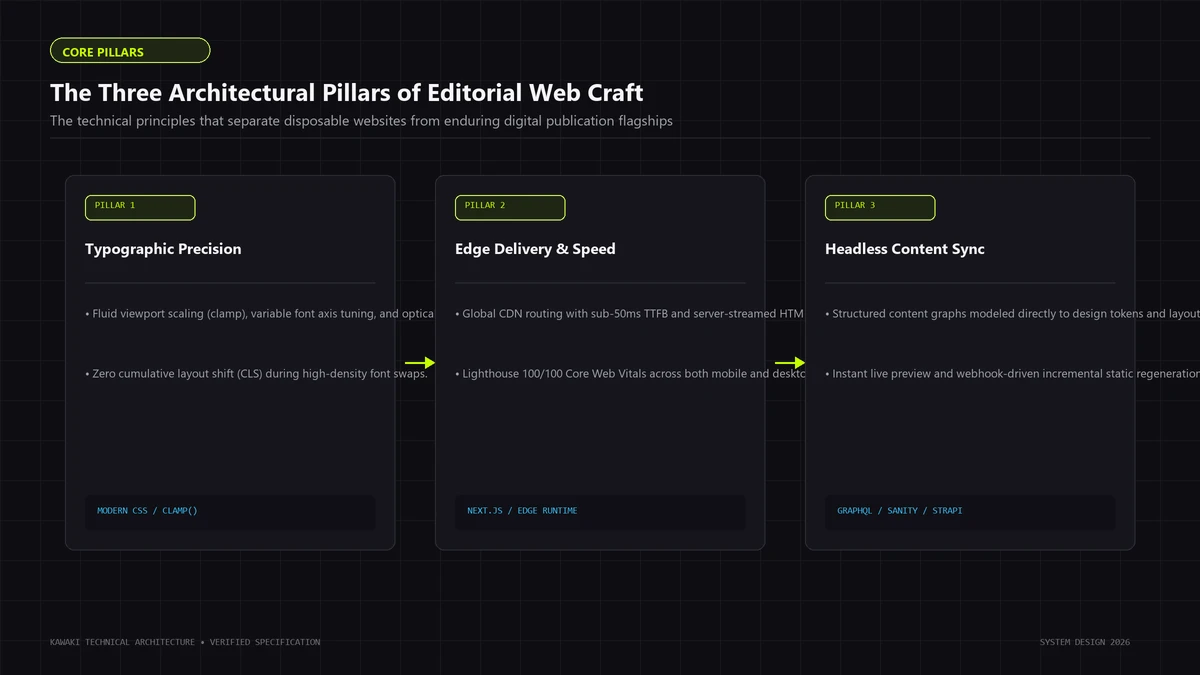
In digital editorial engineering, we translate these classical principles to fluid viewports:
- Fluid Type Scales: Utilizing CSS clamp() mathematics to ensure headline hierarchy scales smoothly across mobile, tablet, and ultra-wide displays without awkward word wraps.
- Serif & Grotesk Dialogue: Pairing expressive display serifs (such as Instrument Serif or Playfair) with rigorous structural sans-serifs (Plus Jakarta Sans, Host Grotesk) creates visual tension between heritage craft and contemporary digital speed.
- Optical Kerning and Tabular Numerals: Ensuring numerical data, financial figures, and timestamps render in monospaced tabular numerals (JetBrains Mono) prevents layout jitter during real-time data updates.
Pillar II: Headless Content Pipelines & Editorial Freedom
Editorial engineering requires modern content orchestration. Monolithic CMS platforms force editorial teams into restrictive WYSIWYG editors that output bloated inline HTML and unoptimized images.
We build headless content architectures leveraging:
- Structured Markdown & MDX Pipelines: Content creators write in clean, distraction-free markdown with custom component embeds.
- Edge Cache Invalidation: Content changes propagate to edge points-of-presence (PoPs) within milliseconds via automated webhooks.
- Decoupled Editorial Dashboards: Engineering custom admin interfaces that mirror the brand's exact publishing workflow, rather than forcing teams into generic administrative dashboards.
Pillar III: Sub-Second Latency and Zero Layout Shift
High-end editorial design often falls victim to performance bloat—uncompressed photography, multiple multi-megabyte font weights, and heavy JavaScript scroll libraries.
At Kawaki Studios, editorial engineering mandates extreme technical hygiene:
- Pre-rendered Static HTML: Essential editorial prose is served directly in static markup, eliminating client-side rendering spinners and providing instant indexation for search engines.
- Critical Font Subsetting: Font files are stripped of unused glyphs, preloaded in the document head, and served with font-display: swap to eliminate Flash of Invisible Text (FOIT).
- GPU-Accelerated Scroll Physics: Smooth scroll engines (like Lenis) are synchronized directly with requestAnimationFrame tickers to ensure 60fps fluidity even on mobile devices.
3. Editorial Engineering in Headless Commerce
While publishing companies were the first to embrace editorial engineering, high-growth direct-to-consumer (DTC) and luxury commerce brands are now adopting it to solve rising customer acquisition costs (CAC).
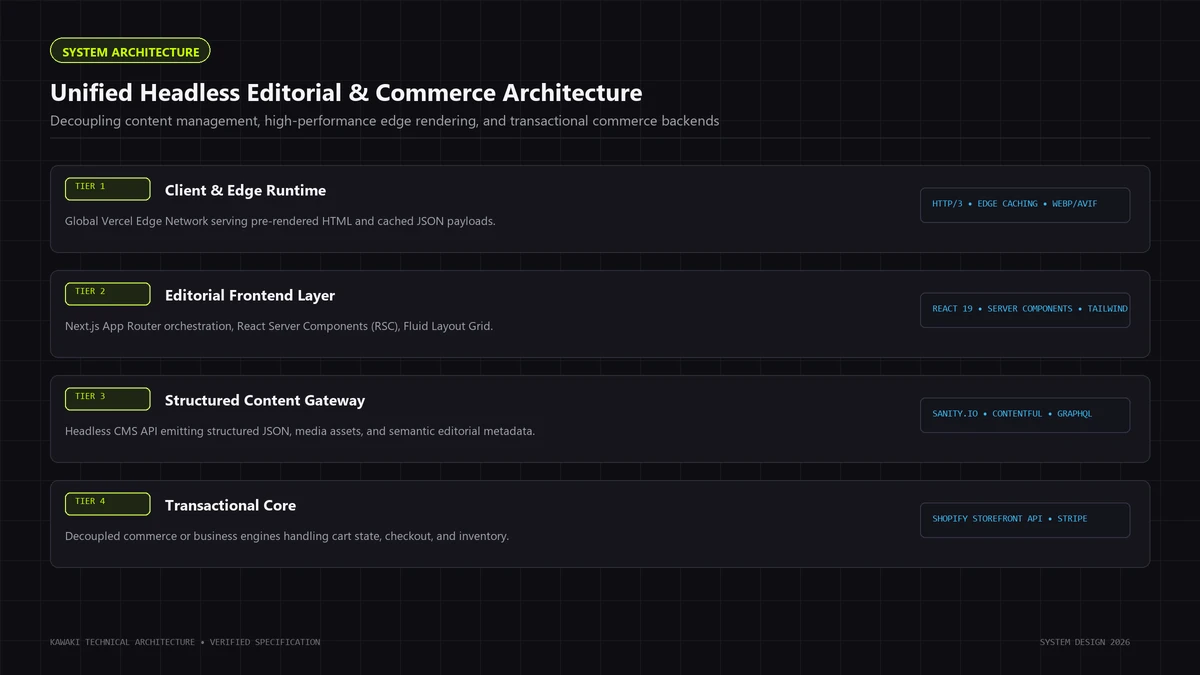
When every competitor uses standard Shopify themes, shopping becomes a generic, transactional chore. Editorial commerce transforms the store into a digital magazine:
- Narrative Product Detail Pages (PDPs): Replacing basic photo carousels with immersive storytelling, origin deep dives, ingredient sourcing breakdowns, and interactive 3D visualizers.
- Seamless Add-to-Cart from Editorial Content: Readers can inspect and purchase featured products directly inside long-form essays without navigating away from the narrative.
- Sub-Second Route Switching: Utilizing headless platforms like Shopify Hydrogen and Next.js, product catalog browsing feels as instantaneous as turning a physical page.
Explore our architectural reference design on decoupled storefront engineering: Acme E-Commerce Architecture Concept.
4. How to Audit Your Platform for Editorial Engineering Readiness
Ask your engineering and creative leadership these five critical diagnostic questions:
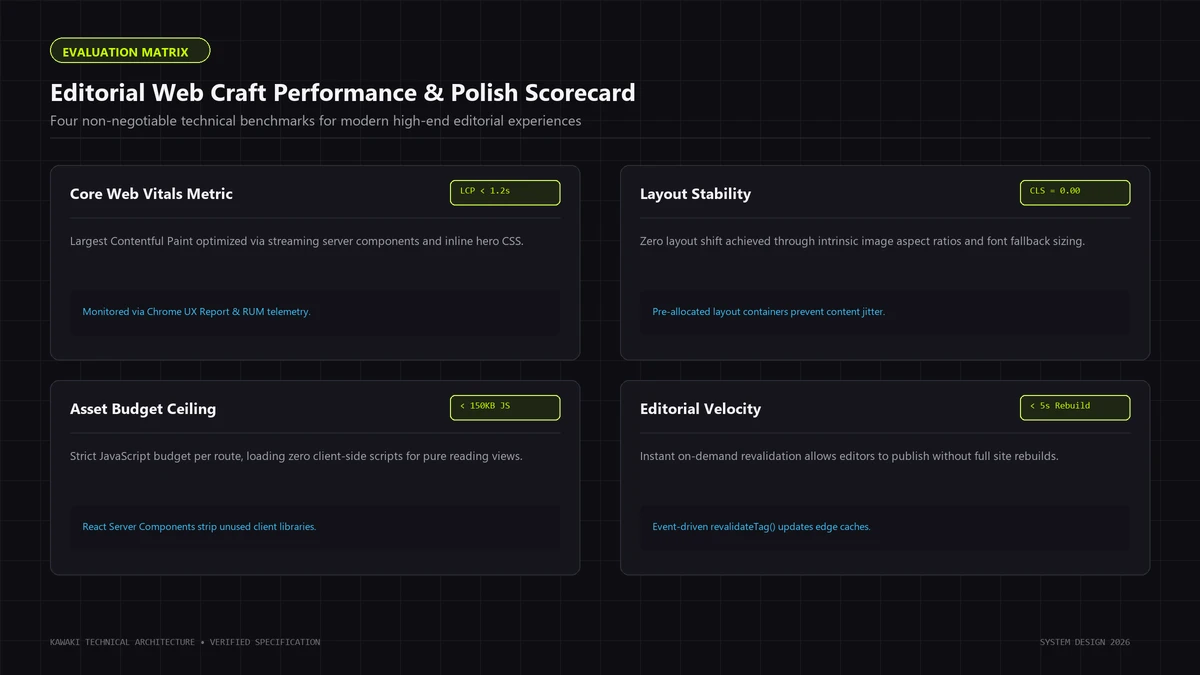
- Mobile LCP: Is your Largest Contentful Paint under 1.0s, or do visitors wait while megabytes of JavaScript hydrate?
- Typographic Hierarchy: Do headlines scale seamlessly using fluid typography, or do they awkwardly clip on narrow viewports?
- Layout Stability: Does your page suffer from layout shift when images or fonts load?
- Content Autonomy: Can your marketing team launch distinct, narrative-driven layouts without filing engineering tickets?
- Structured Search Context: Does every published piece carry semantic JSON-LD metadata for search engines and AI citation models?
5. Frequently Asked Questions (FAQ)
What distinguishes an editorial engineer from a frontend developer?
A standard frontend developer focuses primarily on converting visual wireframes into code and wiring up APIs. An editorial engineer combines senior full-stack engineering proficiency with publication design literacy, typography fundamentals, narrative pacing, and technical SEO architecture.
Can editorial engineering be applied to SaaS and B2B platforms?
Yes. Modern B2B buyers conduct extensive independent research before speaking with sales. High-converting B2B platforms use editorial engineering to present whitepapers, documentation, interactive ROI calculators, and product manifestos as premium publication assets rather than sterile corporate marketing pages.
How does editorial engineering impact SEO and organic search?
By structuring content with semantic HTML5 hierarchies, comprehensive Schema.org JSON-LD structured data, clean URL architectures, and superior Core Web Vitals, editorial platforms consistently rank higher for competitive, high-intent keywords and get cited more frequently by modern AI answer engines (Perplexity, ChatGPT, Google AI Overviews).
Conclusion: Building Digital Flagships that Endure
The internet does not need more forgettable websites. It needs thoughtful, high-performance digital flagships that command respect and captivate attention.
If you are planning a strategic redesign, a headless commerce migration, or a custom editorial platform, schedule a discovery call with Kawaki Studios or explore our Services & Architectural Tiers.
Need Help Engineering Your Web Platform or AI Systems?
From high-performance Next.js architectures to headless Shopify storefronts, custom AI automations, and enterprise WordPress security recovery, Kawaki Studios designs resilient digital infrastructure built to scale.