Executive Summary / Key Takeaways
An architectural guide to AI agent reliability in production. Learn how to engineer deterministic eval harnesses, multi-layer guardrails, and autonomous failure recovery.
- Evaluates agent reliability through pass@k benchmarks, bounded sandbox environments, and regression suites.
- Applies two-tier output validation: schema compliance followed by deterministic domain validation.
- Implements automated circuit breakers and state rollbacks when tool loops detect anomalies.
In enterprise software engineering, business automation has historically depended on determinism: given an input payload, an API executes a compiled abstract syntax tree, commits a database transaction, or returns a typed error. Large Language Models (LLMs) operate under an entirely different paradigm: they are probabilistic reasoning engines predicting next tokens from statistical distributions.
When deployed as autonomous agents—coordinating multiple tool calls, querying external APIs, updating internal state, and executing business operations—models exhibit systemic behavior that simple prompt engineering cannot constrain. A language model generating a plausible answer in an offline playground demonstrates linguistic capability; an agent safely completing an asynchronous multi-step invoice reconciliation demonstrates systemic reliability.
Model intelligence is probabilistic; enterprise reliability must be deterministic.
In AI Automation Architecture: Designing Reliable Workflows, Agents, and Human Approval Loops (R01), we analyzed the system topology of automated workflows, distinguishing linear webhooks from state machines and establishing human approval loops. In this guide (R02), we move from macro-architecture to the core discipline of reliability engineering: eval-driven development, pass@k limitations, defense-in-depth guardrails, structured observation contracts, and transactional failure recovery.
Introduction: The Reliability Gap
The fundamental challenge in enterprise agent deployment is The Reliability Gap: the distance between a model generating a plausible natural-language explanation, an agent completing a multi-step task in isolation, and an enterprise system operating safely under continuous failure.
┌────────────────────────────────────────────────────────────────────────┐
│                        THE RELIABILITY GAP                             │
├──────────────────────────┬─────────────────────────────────────────────┤
│ Level 1: Model Output    │ "The refund for order #1842 has been        │
│ (Linguistic Answer)      │ successfully processed for $49.99."         │
│                          │ ↳ Plausible text, but no action executed.   │
├──────────────────────────┼─────────────────────────────────────────────┤
│ Level 2: Agent Tool Call │ issue_refund({ order_id: 1842 })            │
│ (Isolated Step)          │ ↳ Syntactically formed, but missing amount, │
│                          │   currency, idempotency key, and auth token.│
├──────────────────────────┼─────────────────────────────────────────────┤
│ Level 3: Production      │ Schema validation → Permission check →      │
│ Automation System        │ Idempotent API call → Ledger commit →       │
│ (End-to-End Reliability) │ Invariant verification → Audit event logged.│
│                          │ ↳ Safe, bounded, observable, recoverable.   │
└──────────────────────────┴─────────────────────────────────────────────┘
Production agent failures rarely manifest as clean compilation errors; they exhibit distinct systemic failure modes:
- Hallucinated Branching Decisions: Assuming an unexecuted verification check succeeded without invoking the tool.
- Malformed Tool Arguments: Passing strings for integer cents, omitting currency codes, or injecting null IDs.
- Tool & Schema Drift: Upstream schemas update while agent serialized tool definitions remain static.
- Poisoned Observations: Ingesting multi-megabyte unparsed HTML errors that evict context instructions.
- Stale Distributed State: Assuming remote records remain static, ignoring concurrent mutations.
- Partial Execution: Executing payment and inventory decrements, but failing on shipping labels without compensation.
- The Infinite Apology Trap: Repeatedly re-invoking failed tools with superficial prompt variations.
- Cascading Failures: Downstream workers accepting corrupted intermediate outputs as ground truth.
- Silent State Corruption: Misinterpreting input, writing invalid CRM metadata, and reporting success.
Model capability cannot replace software architecture. System reliability is determined by the harness, guardrails, and recovery loops enclosing the model.
1. What Does "Reliable" Mean for an AI Agent?
In conventional infrastructure, reliability often defaults to availability (e.g., 99.9% uptime). For autonomous agents, availability is insufficient: an agent endpoint can maintain 100% uptime while silently corrupting enterprise records.
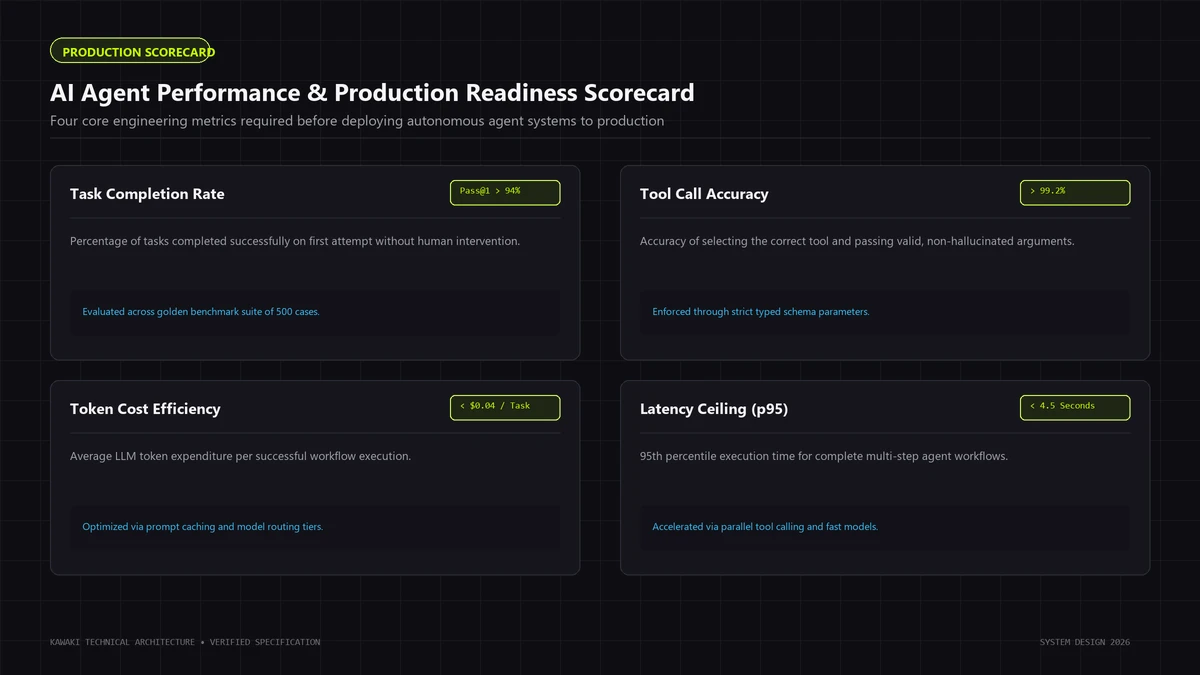
We define agent reliability across seven independent architectural vectors:
                                  ┌────────────────────────┐
                                  │   AGENT RELIABILITY    │
                                  └───────────┬────────────┘
         ┌──────────────┬──────────────┬──────┴───────┬──────────────┬──────────────┐
         ▼              ▼              ▼              ▼              ▼              ▼
  ┌─────────────┐┌─────────────┐┌─────────────┐┌─────────────┐┌─────────────┐┌─────────────┐
  │ Correctness ││   Safety    ││ Consistency ││Recoverability││Observability││   Bounded   │
  └─────────────┘└─────────────┘└─────────────┘└─────────────┘└─────────────┘└─────────────┘
- Correctness: Achieving business goals per specification, producing valid external state mutations.
- Safety: Enforcing least-privilege bounds, preventing credential leaks, and resisting prompt injection.
- Consistency: Showing bounded variance in tool selection and output across semantically equivalent tasks.
- Recoverability: Self-healing transient faults, retrying with backoff, or cleanly rolling back state.
- Observability: Logging every thought, tool call, observation, validation, and mutation in structured telemetry.
- Availability: Gracefully handling provider outages or rate limits via fallback queues.
- Bounded Behavior: Operating within immutable limits on runtime duration, tokens, depth, and budget.
2. The Reliability Architecture
To operationalize these vectors, this guide proposes a Tri-Pillar Reliability Architecture:
┌────────────────────────────────────────────────────────────────────────┐
│                   TRI-PILLAR RELIABILITY ARCHITECTURE                   │
├────────────────────────────────────────────────────────────────────────┤
│  PILLAR I: EVALUATION HARNESS                                          │
│  Continuous offline and regression test suites. Measures single-step   │
│  success, validates tool selection, and detects semantic drift.        │
├────────────────────────────────────────────────────────────────────────┤
│  PILLAR II: RUNTIME GUARDRAILS                                         │
│  Five-layer defense-in-depth boundary: Input, Decision, Tool, Output,  │
│  and Infrastructure constraints enforced outside the model.           │
├────────────────────────────────────────────────────────────────────────┤
│  PILLAR III: FAILURE RECOVERY & ISOLATION                              │
│  Deterministic exception classifiers, exponential backoff with jitter, │
│  Saga-pattern compensation, and human escalation gates.                │
└────────────────────────────────────────────────────────────────────────┘
Closed-Loop Runtime Flow
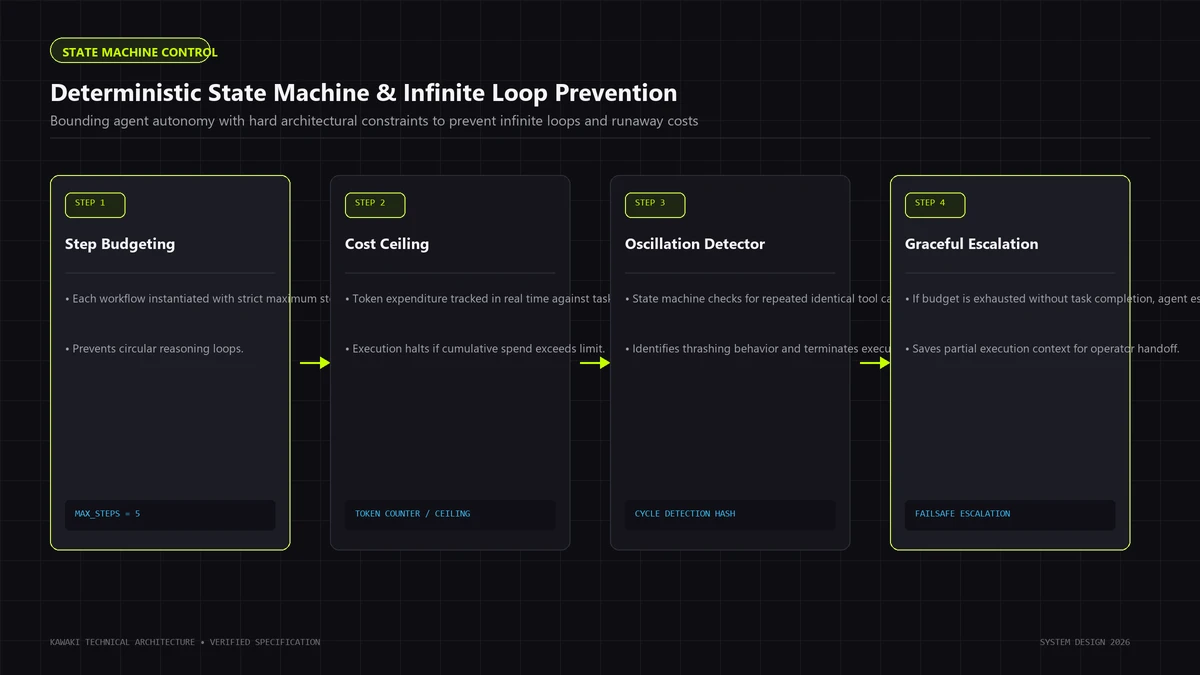
At runtime, agent invocations follow an execution pipeline where models never communicate directly with external systems:
Incoming Request / Webhook
          │
          ▼
┌──────────────────┐
│ Input Guardrails │ ──► [Reject: Invalid Auth / Prompt Injection / Malformed Payload]
└─────────┬────────┘
          │ (Sanitized Task Input)
          ▼
┌──────────────────┐
│ Reasoning Engine │ ◄── (Compact Context & State Snapshot)
│  (LLM Planner)   │
└─────────┬────────┘
          │ (Proposed Action & Tool Call)
          ▼
┌──────────────────┐
│ Tool Guardrails  │ ──► [Reject: Schema Violation / Permission Denied / Out of Budget]
└─────────┬────────┘
          │ (Validated & Authorized Tool Arguments)
          ▼
┌──────────────────┐
│ Safe Tool Runner │ ──► [Executes against External API / Database with Timeout]
└─────────┬────────┘
          │ (Raw Tool Response)
          ▼
┌──────────────────┐
│   Observation    │ ──► [Sanitizes Payload, Truncates Bloat, Masks PII, Formats Contract]
│    Contract      │
└─────────┬────────┘
          │ (Structured Observation Object)
          ▼
┌──────────────────┐
│ State Mutation & │ ──► [Commit Checkpoint / Evaluate Success Invariants]
│ Failure Evaluator│
└─────────┬────────┘
          │
     ┌────┴──────────────────────────┬──────────────────────────┐
     ▼                               ▼                          ▼
[Task Complete]             [Transient Error]           [Fatal / Sensitive]
     │                               │                          │
 Commit & Telemetry         Classify & Backoff           Rollback & Escalate
                            Re-enter Planner Loop         to Human Operator
3. Evaluation-Driven Development (EDD)
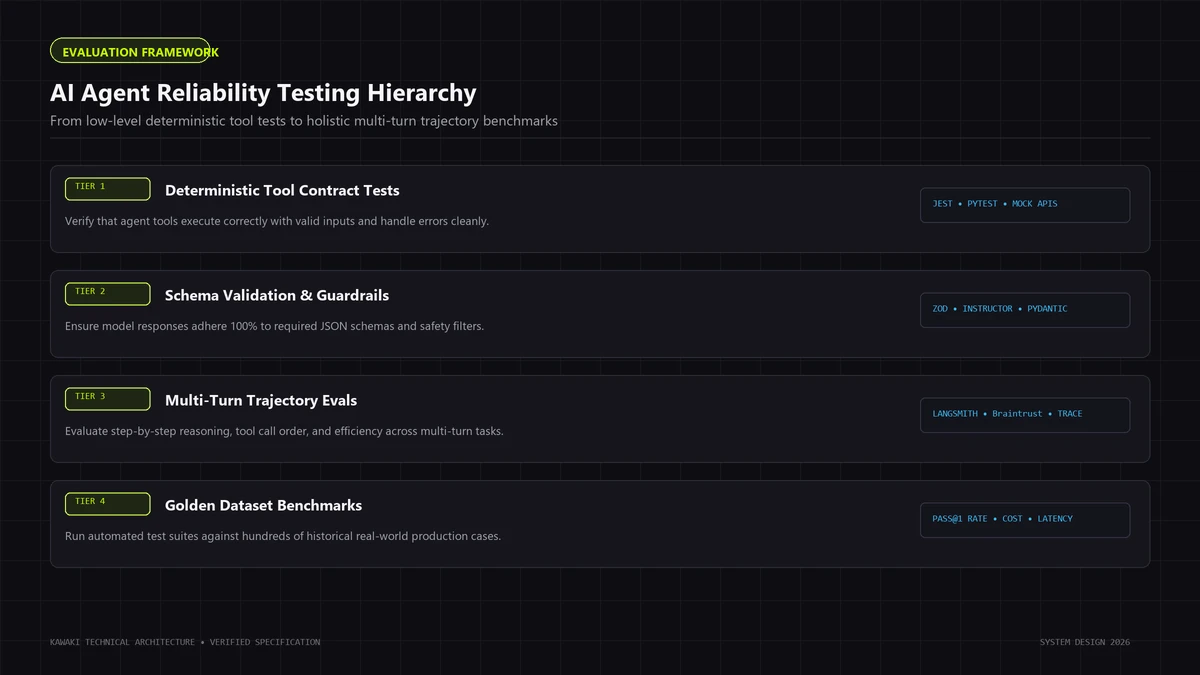
In agent engineering, Evaluation-Driven Development (EDD) mandates that evaluation datasets, mock environments, and grading harnesses precede prompt modifications or model migrations.
Core Evaluation Components
An enterprise evaluation harness requires four foundational artifacts:
- Golden Datasets: Version-controlled corpora of standard tasks, production edge cases, and adversarial prompts.
- Environment Mocks: Deterministic sandboxes mirroring production databases, CRMs, and APIs.
- Execution Traces: Complete recordings of reasoning steps, tool calls, arguments, observations, and latency.
- Automated Graders: Programmatic assertions and hybrid evaluators verifying explicit acceptance criteria.
The Grader Hierarchy
Evaluating an agent requires distinct grading paradigms depending on output type:
| Grader Type | Mechanism | Strengths | Limitations | Optimal Use Case |
|---|---|---|---|---|
| Deterministic Code Grader | Assertions, JSON Schema validation, SQL state assertions, regex parsing. | Deterministically reproducible, zero model token cost, microsecond execution, eliminates model hallucination in grading. | Cannot grade tone, subjective reasoning, or open-ended synthesis. | Tool parameter correctness, state mutations, schema conformance, invariant validation. |
| Model-Based Grader (LLM-as-a-Judge) | Prompted evaluator model using chain-of-thought grading rubrics and reference outputs. | Evaluates complex semantic reasoning, conversation quality, and synthesis. | Probabilistic, subject to position bias, verbosity bias, and calibration drift; incurs token cost. | Evaluating unstructured text summaries, customer communication tone, multi-step justification. |
| Human Evaluation Gate | Domain reviewers inspecting randomized sample batches and edge-case failures. | Ground truth for business alignment, nuance detection, and edge-case triage. | High cost, high latency, cannot scale to continuous integration (CI) pipelines. | Periodic benchmark calibration, audit of escalated failures, establishing golden datasets. |
Limitations of Model-Based Grading
While LLM-as-a-Judge frameworks offer flexibility, treating model grades as ground truth in CI is an anti-pattern due to systematic biases:
- Self-Enhancement Bias: Evaluator models favor completions generated by their own model family over competing architectures.
- Verbosity Bias: Evaluator models consistently award higher scores to longer completions, even when concise answers are more technically precise.
- Position Bias: In pairwise comparisons, models frequently favor whichever candidate is presented first in context.
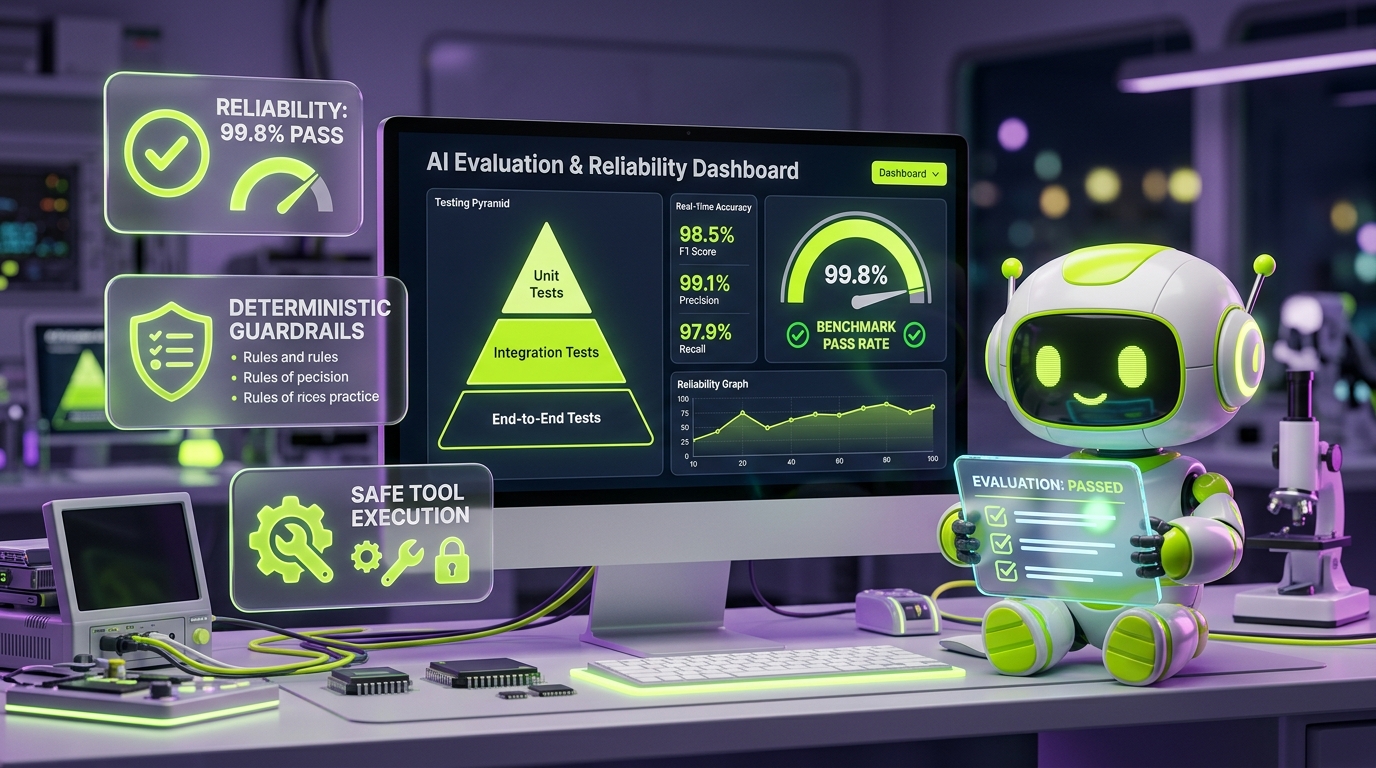
Architectural Rule: In automated CI/CD pipelines, deterministic code graders serve as the primary gating mechanism. Deployments should not rely solely on probabilistic model scores; the harness must verify programmatically that database records match expected state and schema keys conform to specification.
4. pass@k and Agent Evaluation: Mathematics, Scope, and Production Limitations
In AI literature, pass@k is a standard benchmark metric, but its application to production autonomous agents is widely misunderstood.
Mathematical Formulation
The pass@k metric was introduced by Mark Chen et al. (OpenAI, 2021) in "Evaluating Large Language Models Trained on Code" to evaluate Python code synthesis on HumanEval.
Sampling $k$ solutions per problem directly introduces high variance unless sample sizes are massive. To calculate an unbiased estimate of pass@k using $n$ total generated samples ($n \ge k$), the authors formulated:
$$\text{pass}@k := \mathbb{E}_{\text{problems}} \left[ 1 - \frac{\binom{n-c}{k}}{\binom{n}{k}} \right]$$
Where:
- $n$ is total samples generated per task ($n \ge k$, typically $n \ge 100$ in research).
- $c$ is the count of generated samples passing all unit tests.
- $\binom{n}{k}$ is the binomial coefficient.
The term $\frac{\binom{n-c}{k}}{\binom{n}{k}}$ calculates the probability that every sample in a subset of size $k$ is incorrect. Subtracting from 1 gives the exact probability that at least one candidate in $k$ samples passes.
pass@k Scope and Production Constraints
While pass@k is mathematically sound for offline evaluation settings—such as evaluating standalone code synthesis, SQL generation, or translation where multiple candidates can be executed in an isolated sandbox to test whether at least one candidate passes—live side-effecting workflows operate under fundamentally different constraints:
- Live Side Effects: An agent interacting with a payment gateway, customer database, or external API cannot generate $k=5$ candidate tool calls, execute all five concurrently, and discard the four failures. Every mutating tool call has immediate operational consequences.
- Sequential Dependency: In a multi-step workflow spanning sequential tool calls, Step 4 depends directly on the real observation returned by Step 3. Independent candidate sampling across multi-step execution graphs is rarely viable.
- Single-Attempt Operational Relevance: For live side-effecting workflows, single-attempt success is more directly relevant than pass@k, but neither metric alone captures production reliability. If an agent requires multiple attempts to execute an action correctly because earlier attempts wrote invalid records or triggered errors, treating the run as an offline "pass@5 success" ignores the cost, latency, and potential state corruption of those earlier attempts.
True production reliability cannot be reduced to a single benchmark number; it requires evaluating multiple operational dimensions:
- Correctness: Satisfying business post-conditions and producing valid external state mutations.
- Safety & Permissions: Enforcing authorization scopes and preventing credential or data leakage.
- Recoverability: Self-healing transient upstream errors or rolling back via compensating transactions.
- Invariant Enforcement: Ensuring critical business rules and safety boundaries are not violated.
- Observability: Emitting complete, structured telemetry traces for auditability and debugging.
- Availability: Maintaining service continuity under third-party API rate limits and outages.
- Cost & Latency Bounding: Operating within defined token budgets, execution timeouts, and monetary caps.
Operational Reliability Metrics for Live Agents
To monitor production agents truthfully without relying on synthetic or misleading benchmark representations, teams should track concrete operational metrics across the system lifecycle:
┌────────────────────────────────────────────────────────────────────────┐
│                   OPERATIONAL AGENT METRIC MATRIX                      │
├───────────────────────────────┬────────────────────────────────────────┤
│ Metric                        │ Definition & Architectural Focus       │
├───────────────────────────────┼────────────────────────────────────────┤
│ Task Completion Rate (TCR)    │ Percentage of initiated workflows that │
│                               │ satisfy all post-condition invariants  │
│                               │ without unhandled exceptions.          │
├───────────────────────────────┼────────────────────────────────────────┤
│ Invalid Tool-Call Rate (ITR)  │ Frequency of tool invocations failing  │
│                               │ input schema validation per 1,000 steps│
├───────────────────────────────┼────────────────────────────────────────┤
│ Recovery Convergence Rate     │ Percentage of transient tool failures  │
│                               │ that self-heal within bounded retries. │
├───────────────────────────────┼────────────────────────────────────────┤
│ Human Escalation Rate (HER)   │ Percentage of runs requiring operator  │
│                               │ clearance (monitored for drift).       │
├───────────────────────────────┼────────────────────────────────────────┤
│ Invariant Violation Rate      │ Policy target of zero allowed breaches:│
│                               │ attempts to violate rules or limits.   │
├───────────────────────────────┼────────────────────────────────────────┤
│ Cost-per-Successful-Task      │ Total model, tool, and infrastructure  │
│                               │ compute amortized strictly over valid  │
│                               │ completions (excluding failed waste).  │
└───────────────────────────────┴────────────────────────────────────────┘
5. Regression Testing Across Agent Surfaces
In traditional software, updating an unrelated utility does not alter database client behavior. In agent systems, every component shares the prompt context as a global coupling surface: a minor prompt edit or updated parameter description alters attention distributions, inducing behavioral regressions.
The Five Regression Vectors
                       ┌─────────────────────────┐
                       │   REGRESSION VECTORS    │
                       └────────────┬────────────┘
     ┌───────────────┬──────────────┼──────────────┬───────────────┐
     ▼               ▼              ▼              ▼               ▼
┌──────────┐   ┌───────────┐  ┌───────────┐  ┌───────────┐   ┌───────────┐
│  Prompt  │   │   Model   │  │   Tool    │  │ Retrieval │   │ Workflow  │
│ Mutations│   │ Checkpoint│  │  Schemas  │  │ Context   │   │ Topologies│
└──────────┘   └───────────┘  └───────────┘  └───────────┘   └───────────┘
- Prompt Mutations: Adding instructions increases token distance, often degrading parameter extraction on long inputs.
- Model Checkpoint Drift: Upstream checkpoint updates alter formatting heuristics, causing unexpected JSON escaping.
- Tool Schema Modifications: Renaming properties or adding optional objects can disrupt tool selection priority.
- Retrieval & RAG Variations: Adjusting chunking or top-k injects different context tokens, shifting decision paths.
- Workflow Topologies: Reordering DAG steps feeds downstream agents context structured differently than their baseline.
CI/CD Evaluation Matrix
Before merging prompt or agent updates, candidates should pass an automated regression evaluation matrix across frozen test suites:
Example evaluation matrix — values shown below are illustrative placeholders and should be replaced with measured results from the team's own evaluation suite.
[PR Trigger: Modify Agent Prompt or Tool Definition]
                       │
                       ▼
┌────────────────────────────────────────────────────────────────────────────┐
│                 ILLUSTRATIVE REGRESSION EVALUATION MATRIX                  │
├────────────────────┬──────────────┬──────────────┬─────────────────────────┤
│ Test Suite         │ Baseline     │ Candidate    │ Gate Condition          │
├────────────────────┼──────────────┼──────────────┼─────────────────────────┤
│ Schema Validity    │ measured     │ measured     │ No regression allowed   │
│ Tool Selection     │ measured     │ measured     │ Defined threshold       │
│ Policy Invariants  │ measured     │ measured     │ Zero critical violations│
│ Edge Recovery      │ measured     │ measured     │ Defined threshold       │
│ Token Efficiency   │ measured avg │ measured avg │ Within budget envelope  │
└────────────────────┴──────────────┴──────────────┴─────────────────────────┘
                       │
             [Gating Rule Verification]
   ✓ Invariant Violations: Zero Critical Violations
   ✓ Schema Validity: Meets Defined Acceptance Threshold
   ✓ Tool Selection: No Regressions on Core Evaluation Tasks
                       │
                       ▼
             [Gating Passed: Candidate Approved]
6. Defense-in-Depth Guardrails
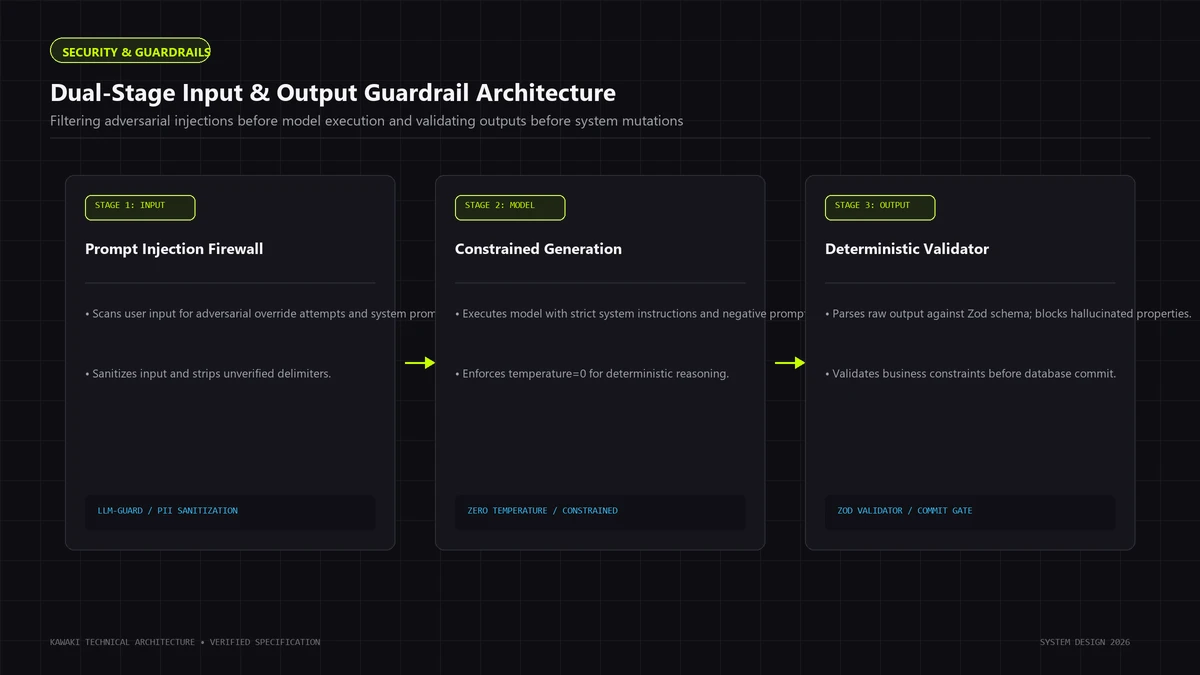
Relying on an LLM to enforce its own operational boundaries is a critical vulnerability. Prompts such as "Please do not issue refunds over $500" are advisory guidelines. Under prompt injection or context confusion, models will violate advisory instructions.
Enterprise reliability requires Defense-in-Depth Guardrails: five deterministic, compiled software layers enforced outside the model:
Incoming Request ─────────────────────────────────────────────────────────┐
                                                                          │
  [LAYER 1: INPUT GUARDRAILS]                                             │
  • Cryptographic Authentication & JWT Scoping                            │
  • Delimiter Sandboxing & Prompt Injection Sanitization                  │
  • Task Intent & Scope Boundaries                                        │
                                                                          ▼
  [LAYER 2: DECISION GUARDRAILS]                                          │
  • Finite State Machine Action Scoping (Only allow Step N tools)         │
  • Deterministic Policy Overrides                                        │
  • Confidence Threshold Gates                                            │
                                                                          ▼
  [LAYER 3: TOOL CALLING GUARDRAILS]                                      │
  • Strict Schema Validation (Zod / JSON Schema)                          │
  • Least-Privilege Scoped API Keys (Per-tool credentials)                │
  • Idempotency Key Injection & Dry-Run Verification                      │
                                                                          ▼
  [LAYER 4: OUTPUT GUARDRAILS]                                            │
  • Business Rule & Domain Invariant Verification                         │
  • Destination & Domain Allowlist Checking                               │
  • Sensitive Data & Secret Redaction (Regex / PII Scanners)              │
                                                                          ▼
  [LAYER 5: INFRASTRUCTURE GUARDRAILS]                                    │
  • Hard Execution Timeouts (Wall-clock circuit breakers)                 │
  • Token & Cost Quota Allocations per Session                            │
  • Concurrency & Rate Limit Envelopes                                    │
                                                                          ▼
Execution Committed to External System ───────────────────────────────────┘
Model Controls vs. Deterministic Controls
- Model-Level Controls (Probabilistic / Advisory): System instructions, few-shot examples, chain-of-thought formatting prompts. These guide reasoning and improve task alignment, but do not provide a hard security boundary.
- Deterministic Controls (Engineered Software Boundaries): Schema validators, cryptographic checks, network firewalls, database transactions, execution timeouts, and hardcoded parameter caps. These run in native application code and cannot be overridden through ordinary model output.
7. Tool Calling Reliability
In production, agents rarely fail syntax; they fail because payloads violate API boundary constraints.
The Semantic vs. Structural Gap
Consider an e-commerce agent handling return inquiries:
User: "I received damaged goods for order 1842. Please process a full refund to my card."
Model Thought: "The customer order is 1842. I will process a full refund now."
Natural Language Output: "I have submitted a full refund for your order #1842."
If connected to an unvalidated API, the agent might emit:
{
  "orderId": "1842",
  "refundReason": "damaged goods"
}
However, the enterprise billing microservice requires an exact UUID format, amount in integer minor units (cents), an ISO-4217 currency code, and an idempotency key. Without runtime validation, the call fails with HTTP 400 Bad Request, polluting the context and derailing the task.
Strict Schema Enforcement with Zod
Below is an illustrative TypeScript implementation demonstrating how strict schema wrappers intercept invalid parameters in memory before network transmission:
import { z } from 'zod';

export const ProcessRefundSchema = z.object({
  orderId: z.string()
    .regex(/^ord_live_[a-f0-9]{16}$/, "Must be a valid production order identifier"),
  amountInCents: z.number()
    .int("Amount must be in integer minor units")
    .positive("Refund amount must be strictly greater than zero")
    .max(500000, "Single-transaction autonomous refund cap is $5,000.00"),
  currency: z.enum(['USD', 'EUR', 'GBP', 'INR']),
  reasonCode: z.enum([
    'DAMAGED_IN_TRANSIT',
    'DEFECTIVE_PRODUCT',
    'INCORRECT_ITEM_SENT',
    'CUSTOMER_SATISFACTION_POLICY'
  ]),
  idempotencyKey: z.string().uuid("Must provide a valid UUID v4 idempotency token")
}).strict(); // Disallow unmapped hallucinated properties

export type ProcessRefundInput = z.infer<typeof ProcessRefundSchema>;
The .strict() modifier rejects unexpected fields, preventing models from injecting hallucinated properties that disrupt backend parsers.
8. Observation Contracts
When an API executes, dumping raw responses into the agent context is hazardous:
- Context Flooding: A database query returning 500 rows injects tens of thousands of tokens, evicting system instructions.
- Security Leakage: Stack traces often expose database table names, hostnames, or internal keys.
- Ambiguous Recovery Cues: Raw traces confuse models, leading to misdiagnosed errors.
The Structured Observation Contract
All tool executions must return a standardized Observation Contract:
export interface ObservationContract<T = unknown> {
  status: 'SUCCESS' | 'VALIDATION_ERROR' | 'SYSTEM_ERROR' | 'POLICY_BLOCKED';
  summary: string;
  data?: T;
  rootCauseHint?: string;
  retryable: boolean;
  safeRetryInstruction?: string;
}
Example: Transforming an API Failure
When a payment gateway rejects an expired card, the runtime interceptor converts the raw HTTP 422 payload into an actionable contract:
{
  "status": "POLICY_BLOCKED",
  "summary": "Payment authorization rejected: Card expired.",
  "rootCauseHint": "PAYMENT_METHOD_EXPIRED",
  "retryable": false,
  "safeRetryInstruction": "Do not retry this card. Prompt user to provide an alternative payment method."
}
By providing explicit retryable: false directives, the system prevents the agent from burning tokens in futile retry loops.
9. Failure Recovery Taxonomy
To handle failures predictably, an agent architecture must categorize every runtime event into a structured Failure Taxonomy:
┌────────────────────────────────────────────────────────────────────────┐
│                        AGENT FAILURE TAXONOMY                          │
├─────────────────────┬───────────────────┬──────────────────────────────┤
│ Failure Class       │ Example Cause     │ Recovery Strategy            │
├─────────────────────┼───────────────────┼──────────────────────────────┤
│ 1. Validation       │ Malformed schema, │ Feed validation errors back  │
│    Failure          │ invalid types.    │ to model; max 2 attempts.    │
├─────────────────────┼───────────────────┼──────────────────────────────┤
│ 2. Transient Infra  │ 429 Rate Limit,   │ Pause agent reasoning.       │
│    Failure          │ 503 Gateway, DNS. │ Execute backoff + jitter.    │
├─────────────────────┼───────────────────┼──────────────────────────────┤
│ 3. Auth & Perms     │ Token expired,    │ Escalate immediately.        │
│    Failure          │ 403 Forbidden.    │ Never retry without new auth.│
├─────────────────────┼───────────────────┼──────────────────────────────┤
│ 4. Business Rule    │ Over refund limit,│ Halt branch. Prompt model to │
│    Violation        │ invalid state.    │ choose alternative workflow. │
├─────────────────────┼───────────────────┼──────────────────────────────┤
│ 5. External Target  │ API deprecation,  │ Trigger Saga compensating    │
│    Unrecoverable    │ Entity not found. │ actions; fail gracefully.    │
├─────────────────────┼───────────────────┼──────────────────────────────┤
│ 6. Model Reasoning  │ Identical tool    │ Break loop; force human      │
│    Deadlock         │ loop (N >= 3).    │ intervention ticket.         │
└─────────────────────┴───────────────────┴──────────────────────────────┘
The operational loop is uncompromising: Detect $\rightarrow$ Classify $\rightarrow$ Route. Compiled TypeScript middleware intercepts exceptions, categorizes them against the taxonomy, and enforces recovery protocols.
10. Retry Engineering: Exponential Backoff and Full Jitter
When upstream services experience transient instability, fixed retry intervals synchronize client requests, creating a thundering herd that prolongs outages.
Jitter Formulation
In "Exponential Backoff and Jitter" (AWS Architecture Blog, 2015), Marc Brooker demonstrated that adding randomized variance ("jitter") to exponential backoff minimizes system latency and queue depth under contention.
The standard exponential ceiling is calculated as:
$$t_{\text{temp}} = \min(t_{\text{cap}}, t_{\text{base}} \times 2^{\text{attempt}})$$
Under Full Jitter, the actual sleep duration is sampled uniformly between zero and the ceiling:
$$t_{\text{sleep}} = \text{random}(0, t_{\text{temp}})$$
Where $t_{\text{base}}$ is initial delay (e.g., 500ms), $t_{\text{cap}}$ is the maximum backoff ceiling (e.g., 15,000ms), and $\text{attempt}$ is the consecutive retry index ($0, 1, 2 \dots$).
Illustrative TypeScript Implementation: Full Jitter Backoff
export interface RetryConfig {
  maxRetries: number;
  baseDelayMs: number;
  maxDelayMs: number;
}

export const DEFAULT_RETRY_CONFIG: RetryConfig = {
  maxRetries: 3,
  baseDelayMs: 500,
  maxDelayMs: 15000,
};

export async function executeWithRetry<T>(
  operation: (attempt: number) => Promise<T>,
  isRetryable: (error: unknown) => boolean,
  config: RetryConfig = DEFAULT_RETRY_CONFIG
): Promise<T> {
  let attempt = 0;

  while (true) {
    try {
      return await operation(attempt);
    } catch (error) {
      attempt++;

      if (attempt > config.maxRetries || !isRetryable(error)) {
        throw error;
      }

      const exponentialCeiling = Math.min(
        config.maxDelayMs,
        config.baseDelayMs * Math.pow(2, attempt - 1)
      );

      const jitteredSleepMs = Math.floor(Math.random() * exponentialCeiling);

      console.warn(
        `[Retry Engine] Transient failure on attempt ${attempt}/${config.maxRetries}. ` +
        `Backing off for ${jitteredSleepMs}ms (Full Jitter). Error: ${(error as Error).message}`
      );

      await new Promise((resolve) => setTimeout(resolve, jitteredSleepMs));
    }
  }
}
11. Transactional Isolation and State Recovery (Saga Patterns)
In multi-step workflows (e.g., Step 1: Provision account → Step 2: Reserve domain → Step 3: Allocate IP → Step 4: Create subscription), a failure at Step 4 leaves previous resources orphaned if unhandled.
The Saga Pattern for Autonomous Workflows
The Saga Pattern (Garcia-Molina & Salem, 1987) manages distributed transactions without two-phase locking. In agent workflows, every forward-mutating tool is paired with a registered Compensating Action:
FORWARD EXECUTION PATH:
[Step 1: Provision Account] ──► [Step 2: Reserve Domain] ──► [Step 3: Assign IP] ──► [Step 4: Subscription FAILS]
                                                                                              │
BACKWARD COMPENSATING PATH:                                                                   ▼
[Compensate 1: Deprovision] ◄── [Compensate 2: Release Domain] ◄── [Compensate 3: Release IP] ◄┘
ACID vs. Agent Saga Workflows
| Characteristic | Traditional Database (ACID) | AI Agent Workflow (Saga) |
|---|---|---|
| Transaction Boundary | Single database instance or distributed 2PC. | Spans external SaaS APIs, microservices, and third-party vendors. |
| Isolation Mechanism | Row/Table locks preventing concurrent dirty reads. | No global locks; operations are immediately visible across systems. |
| Rollback Mechanism | Database undo logs revert binary storage blocks. | Compensating business operations run in reverse order (e.g., refund API). |
| Execution Horizon | Milliseconds. | Seconds, minutes, or days (spanning human approval windows). |
| Consistency Model | Immediate strict consistency. | Eventual consistency; intermediate states are explicitly handled. |
Illustrative State Persistence Contract
To survive process crashes, orchestrators can serialize the execution graph to persistent storage after every successful step (illustrative TypeScript contract):
export interface WorkflowCheckpoint {
  workflowId: string;
  stepIndex: number;
  stateSnapshot: Record<string, unknown>;
  completedSteps: Array<{
    toolName: string;
    arguments: Record<string, unknown>;
    result: unknown;
    compensatingActionName?: string;
    compensatingArguments?: Record<string, unknown>;
  }>;
  status: 'IN_PROGRESS' | 'AWAITING_APPROVAL' | 'FAILED' | 'COMPLETED';
  updatedAt: string;
}
If a container restarts mid-task, the agent resumes from the latest checkpoint rather than restarting from zero.
12. Human-in-the-Loop (HITL) & Escalation Matrices
True reliability does not require eliminating human involvement; it requires algorithmically identifying the boundary of safe autonomy and escalating when actions exceed risk thresholds.
The Risk-Based Escalation Matrix
┌────────────────────────────────────────────────────────────────────────┐
│                   RISK-BASED ESCALATION MATRIX                         │
├─────────────────────┬──────────────┬──────────────────┬────────────────┤
│ Dimension           │ Low Risk     │ Medium Risk      │ High Risk      │
│                     │ (Autonomous) │ (Notify/Log)     │ (Block & Gate) │
├─────────────────────┼──────────────┼──────────────────┼────────────────┤
│ Financial Value     │ < $50.00     │ $50.00 – $500.00 │ > $500.00      │
│ Reversibility       │ Instant undo │ Complex rollback │ Irreversible   │
│ Security Privilege  │ Read-only    │ Tenant metadata  │ Role/Perm/Keys │
│ Compliance Exposure │ Internal log │ Customer profile │ PII / Tax / IP │
└─────────────────────┴──────────────┴──────────────────┴────────────────┘
Asynchronous Pause/Resume Pattern
When an action triggers High Risk:
- The agent serializes its execution checkpoint.
- The orchestrator issues an approval request displaying intended actions, parameters, and estimated impact.
- The execution thread enters
AWAITING_APPROVALstatus, releasing compute resources. - Upon webhook authorization, the worker thread hydrates from the checkpoint and resumes execution.
13. Multi-Agent Reliability & Coordination Topology
When scaling agent workflows, teams often default to multi-agent swarms. However, multi-agent topologies introduce substantial failure surface.
Coordination Topologies
  SUPERVISOR ──► WORKER PATTERN               PEER / DAG PATTERN
         ┌────────────┐                         ┌─────────────┐
         │ Supervisor │                         │ Data Ingest │
         └─────┬──────┘                         └──────┬──────┘
       ┌───────┴───────┐                               ▼
       ▼               ▼                        ┌─────────────┐
 ┌───────────┐   ┌───────────┐                  │ Synthesis   │
 │ Analyst A │   │ Writer B  │                  └──────┬──────┘
 └───────────┘   └───────────┘                         ▼
   (Centralized Evaluation & Checkpoints)       ┌─────────────┐
                                                │ Execution   │
                                                └─────────────┘
                                           (Deterministic Artifact Edges)
- Supervisor-Worker: A centralized supervisor decomposes goals, assigns sub-tasks to specialist workers, and validates outputs before integration. This provides high reliability because the supervisor maintains an authoritative state checkpoint.
- Peer / DAG Workflows: Agents execute along a directed graph, passing validated artifacts downstream. This is efficient for linear pipelines but vulnerable if upstream errors compound.
Anti-Patterns to Avoid
- Circular Delegation Deadlocks: Agent A delegates to Agent B, which delegates back to Agent A, generating an infinite billing loop.
- Context Explosion across Handoffs: Passing raw conversational histories between workers degrades attention. Agents must exchange typed artifact contracts.
- Over-Agentification: Deploying five agents where one deterministic script and a single LLM prompt suffice multiplies cost and failure surface unnecessarily.
14. Context Management: Protecting the Signal-to-Noise Ratio
Context window size does not guarantee retrieval accuracy. Research demonstrates the "Lost in the Middle" phenomenon: models retrieve information at the boundaries of long context windows significantly more reliably than information in the center.
Three Rules of Context Hygiene
- Compaction at Phase Boundaries: Transitioning between phases purges raw exploration logs, replacing tool turns with a validated state summary.
- Dynamic Tool Masking: Expose only tools relevant to the current workflow stage via finite state control.
- Reference-Based Observations: When tools generate massive payloads, persist data in object storage and return a reference handle with schema metadata:
{
  "status": "SUCCESS",
  "artifactHandle": "s3://enterprise-artifacts/reports/inv_982.json",
  "summary": "1,420 records parsed. Net balance: $42,150.00.",
  "availableFilters": ["by_department", "by_vendor_id", "flagged_anomalies"]
}
The agent queries targeted subsets through filter tools, preserving the context budget for active reasoning.
15. Illustrative TypeScript Implementation: End-to-End Tool Harness
Below is an illustrative TypeScript reference implementation demonstrating how input validation, authorization checks, jittered retry, observation contracts, and structured audit logging can be unified into a single tool wrapper. This example is an architectural reference pattern rather than a proprietary deployed codebase:
import { z } from 'zod';

export const CustomerUpdateInputSchema = z.object({
  customerId: z.string().regex(/^cust_[a-zA-Z0-9]{12}$/, "Invalid Customer ID format"),
  email: z.string().email("Invalid email address"),
  tier: z.enum(['STANDARD', 'PREMIUM', 'ENTERPRISE']),
  reason: z.string().min(10, "A substantive audit justification is required"),
}).strict();

export type CustomerUpdateInput = z.infer<typeof CustomerUpdateInputSchema>;

export interface ObservationContract<T = unknown> {
  status: 'SUCCESS' | 'VALIDATION_ERROR' | 'SYSTEM_ERROR' | 'POLICY_BLOCKED';
  summary: string;
  data?: T;
  rootCauseHint?: string;
  retryable: boolean;
  safeRetryInstruction?: string;
}

export interface SecurityContext {
  userId: string;
  tenantId: string;
  scopes: string[];
}

export interface AuditLogEvent {
  eventId: string;
  timestamp: string;
  taskId: string;
  toolName: string;
  caller: SecurityContext;
  status: string;
  latencyMs: number;
}

async function withFullJitterRetry<T>(
  operation: () => Promise<T>,
  maxRetries = 3,
  baseDelayMs = 400,
  maxDelayMs = 8000
): Promise<T> {
  let attempt = 0;
  while (true) {
    try {
      return await operation();
    } catch (err) {
      attempt++;
      if (attempt > maxRetries) throw err;

      const ceiling = Math.min(maxDelayMs, baseDelayMs * Math.pow(2, attempt - 1));
      const jitteredMs = Math.floor(Math.random() * ceiling);
      await new Promise(r => setTimeout(r, jitteredMs));
    }
  }
}

export class ReliableCustomerToolHarness {
  private requiredScope = 'customers:write';

  constructor(
    private crmApiClient: { updateCustomer: (data: CustomerUpdateInput) => Promise<{ updated: boolean }> },
    private telemetrySink: { emit: (event: AuditLogEvent) => Promise<void> }
  ) {}

  public async executeTool(
    rawArguments: unknown,
    securityContext: SecurityContext,
    taskId: string
  ): Promise<ObservationContract> {
    const startTime = Date.now();
    const eventId = `evt_${Math.random().toString(36).substring(2, 11)}`;

    try {
      // Step 1: Permission Guardrail
      if (!securityContext.scopes.includes(this.requiredScope)) {
        await this.logAudit(eventId, taskId, securityContext, 'POLICY_BLOCKED', startTime);
        return {
          status: 'POLICY_BLOCKED',
          summary: 'Security Error: Invoking agent lacks required permission scope.',
          rootCauseHint: 'INSUFFICIENT_SCOPE_PRIVILEGE',
          retryable: false,
          safeRetryInstruction: 'Do not re-attempt. Escalate to operator for elevated permissions.'
        };
      }

      // Step 2: Input Schema Guardrail
      const parseResult = CustomerUpdateInputSchema.safeParse(rawArguments);
      if (!parseResult.success) {
        await this.logAudit(eventId, taskId, securityContext, 'VALIDATION_ERROR', startTime);
        const errorDetails = parseResult.error.issues
          .map(i => `${i.path.join('.')}: ${i.message}`)
          .join('; ');

        return {
          status: 'VALIDATION_ERROR',
          summary: `Tool parameters failed schema verification: ${errorDetails}`,
          rootCauseHint: 'SCHEMA_VIOLATION',
          retryable: true,
          safeRetryInstruction: 'Correct parameter formatting before retrying.'
        };
      }

      const validatedInput = parseResult.data;

      // Step 3: Execution with Jittered Retry
      const apiResponse = await withFullJitterRetry(async () => {
        return await this.crmApiClient.updateCustomer(validatedInput);
      });

      // Step 4: Success Observation & Audit
      await this.logAudit(eventId, taskId, securityContext, 'SUCCESS', startTime);

      return {
        status: 'SUCCESS',
        summary: `Successfully updated customer profile ${validatedInput.customerId} to ${validatedInput.tier} tier.`,
        data: apiResponse,
        retryable: false
      };

    } catch (unhandledError) {
      await this.logAudit(eventId, taskId, securityContext, 'SYSTEM_ERROR', startTime);
      return {
        status: 'SYSTEM_ERROR',
        summary: 'External CRM service unavailable or connection timed out.',
        rootCauseHint: 'UPSTREAM_API_TIMEOUT',
        retryable: true,
        safeRetryInstruction: 'Transient outage detected. Retry with exponential backoff.'
      };
    }
  }

  private async logAudit(
    eventId: string,
    taskId: string,
    caller: SecurityContext,
    status: string,
    startTime: number
  ): Promise<void> {
    await this.telemetrySink.emit({
      eventId,
      timestamp: new Date().toISOString(),
      taskId,
      toolName: 'update_customer_profile',
      caller,
      status,
      latencyMs: Date.now() - startTime
    });
  }
}
16. Observability and Telemetry Architecture
Operating autonomous agents without fine-grained telemetry makes diagnosing regressions impossible. Standard server logs reveal nothing about underlying reasoning failures.
Core Telemetry Events
An observable infrastructure emits discrete, structured audit events:
task_started: Goal specification, caller identity, token quota.reasoning_step: Step counter, token consumption, latency.tool_requested: Model-proposed tool name and argument payload.guardrail_blocked: Interception cause (schema error, scope violation, budget limit).tool_executed: Validated execution, duration, upstream status.observation_formatted: Observation contract emitted back to context.retry_scheduled: Jitter delay, attempt count, classified error.human_escalation: Risk threshold exceeded, approval ticket reference.compensating_action: Saga rollback action, target entity, status.task_completed: Final resolution, total tokens, net operational cost.
Never log raw context dumps containing authorization tokens or PII into telemetry sinks. Payloads must pass through redaction pipelines before persistence.
17. Production Readiness Checklist
Before deploying an autonomous agent into production workflows, audit the architecture against this 10-point readiness checklist:
┌────────────────────────────────────────────────────────────────────────┐
│               ENTERPRISE AGENT READINESS CHECKLIST                     │
├────┬──────────────────────┬────────────────────────────────────────────┤
│ [ ]│ 1. Golden Evaluation │ Comprehensive test set of historical cases │
│    │    Dataset           │ and edge failures established.             │
├────┼──────────────────────┼────────────────────────────────────────────┤
│ [ ]│ 2. CI Regression     │ Automated pass/fail gating verifying zero  │
│    │    Gating            │ invariant regressions on every code merge. │
├────┼──────────────────────┼────────────────────────────────────────────┤
│ [ ]│ 3. Strict Input      │ All tool inputs validated via Zod/JSON     │
│    │    Schemas           │ Schema with strict property disallowance.  │
├────┼──────────────────────┼────────────────────────────────────────────┤
│ [ ]│ 4. Least-Privilege   │ Tools operate with scoped credentials; no  │
│    │    Permissions       │ universal master API keys in runtime.      │
├────┼──────────────────────┼────────────────────────────────────────────┤
│ [ ]│ 5. End-to-End        │ Mutating actions enforce unique UUIDv4     │
│    │    Idempotency       │ keys to prevent duplicate side effects.    │
├────┼──────────────────────┼────────────────────────────────────────────┤
│ [ ]│ 6. Jittered Retry    │ Transient failures use full jitter backoff;│
│    │    Policies          │ hard maximum retry caps strictly enforced. │
├────┼──────────────────────┼────────────────────────────────────────────┤
│ [ ]│ 7. Deterministic     │ Machine-classified error taxonomy directs  │
│    │    Error Taxonomy    │ retryability, not subjective model logic.  │
├────┼──────────────────────┼────────────────────────────────────────────┤
│ [ ]│ 8. Human Escalation  │ Risk-based triggers halt execution for     │
│    │    Gates             │ high-value or irreversible mutations.      │
├────┼──────────────────────┼────────────────────────────────────────────┤
│ [ ]│ 9. Immutable Audit   │ Structured telemetry logs every thought,   │
│    │    Logging           │ tool call, observation, and state change.  │
├────┼──────────────────────┼────────────────────────────────────────────┤
│ [ ]│10. Token & Cost      │ Hard execution timeouts and dollar-denom-  │
│    │    Budgets           │ inated session spending limits enforced.   │
└────┴──────────────────────┴────────────────────────────────────────────┘
18. When NOT to Use an Autonomous Agent
A critical architectural decision is recognizing when not to introduce an autonomous agent: adding probabilistic models to deterministic workflows adds latency, cost, and failure vectors.
┌────────────────────────────────────────────────────────────────────────┐
│                   DETERMINISTIC VS. AGENTIC SELECTION                  │
├───────────────────────────────────┬────────────────────────────────────┤
│ USE DETERMINISTIC CODE (NO AGENT) │ USE AN AUTONOMOUS AGENT            │
├───────────────────────────────────┼────────────────────────────────────┤
│ • Fixed, static business rules    │ • Ambiguous natural-language inputs│
│ • Predictable JSON transformations│ • Dynamic API tool exploration     │
│ • Latency-critical sub-100ms APIs │ • Multi-source semantic synthesis  │
│ • Strict financial calculations   │ • Unstructured exception triage    │
│ • High-volume standard webhooks   │ • Open-ended task planning         │
└───────────────────────────────────┴────────────────────────────────────┘
The optimal architecture is hybrid: deterministic code handles auth, routing, and transactions, while agent reasoning is reserved for unstructured ambiguity resolution.
Frequently Asked Questions
What is the fundamental difference between LLM accuracy and agent reliability?
LLM accuracy measures whether a model generates a correct response to a static text prompt. Agent reliability measures whether a system can execute a multi-step workflow across external APIs, self-heal transient errors, preserve security invariants, and reach a verified goal state without unintended side effects.
Why is pass@k not suitable as a direct production reliability metric?
The pass@k metric calculates the probability that at least one of k generated candidates passes offline unit tests, which is useful when evaluating model capabilities in isolated sandboxes. In production automation with live side effects (such as payments or database mutations), an agent cannot execute multiple speculative attempts against external systems and discard the failures. For live side-effecting workflows, single-attempt success is more directly relevant than pass@k, but neither metric alone captures production reliability. Production systems require a multi-dimensional framework evaluating correctness, safety boundaries, recoverability, invariant enforcement, observability, availability, and cost.
How do you prevent an AI agent from entering an infinite retry loop?
Infinite loops are prevented by enforcing a hard maximum retry cap (typically 3 attempts) per step, returning structured observation contracts where the system sets retryable: false on unrecoverable errors, and executing loop-detection middleware that halts execution if an identical tool signature is invoked consecutively.
What is the difference between model-level instructions and deterministic guardrails?
Model-level instructions are advisory prompts that guide reasoning but can be bypassed under adversarial inputs or context confusion. Deterministic guardrails are programmatic software controls (such as schema validators, cryptographic permission checks, and execution timeouts) enforced outside the model in application runtime that cannot be overridden through ordinary model output.
When should an AI agent workflow mandate human-in-the-loop approval?
Workflows should mandate human approval when actions cross high-risk operational thresholds: financial transactions exceeding pre-set limits, irreversible data mutations, credential or permission alterations, and sensitive compliance operations.
How does the Saga pattern apply to distributed AI agent workflows?
Because distributed agent workflows span third-party APIs where database locks are impossible, the Saga pattern pairs every mutating tool with an explicit compensating action. If a downstream step fails permanently, the orchestrator executes compensating actions in reverse order to restore enterprise consistency.
Conclusion & Next Steps
Deploying autonomous agents into enterprise systems requires reliability engineering: model capability is the engine, but deterministic software architecture provides the steering, transmission, and brakes. By establishing evaluation-driven development pipelines, multi-layer guardrails, structured observation contracts, and Saga recovery workflows, organizations can substantially reduce failure risks and operate autonomous workflows with measurable operational assurance.
Related Architectural Resources
- AI Automation Architecture: Designing Reliable Workflows, Agents, and Human Approval Loops: Explore R01 for foundational system topology, state machine design, and human-in-the-loop patterns.
- Enterprise AI Automation Services: Learn about Kawaki Studios' architectural approach to designing and structuring hardened, bounded automated workflows.
- Custom Web Application Development: Discover our full-stack engineering standards for Next.js architectures, sub-second latency, and scalable digital platforms.
If your organization is designing mission-critical AI workflows or needs an architectural audit of existing agent systems, schedule a technical discovery session with Kawaki Studios.
Need Help Engineering Your Web Platform or AI Systems?
From high-performance Next.js architectures to headless Shopify storefronts, custom AI automations, and enterprise WordPress security recovery, Kawaki Studios designs resilient digital infrastructure built to scale.