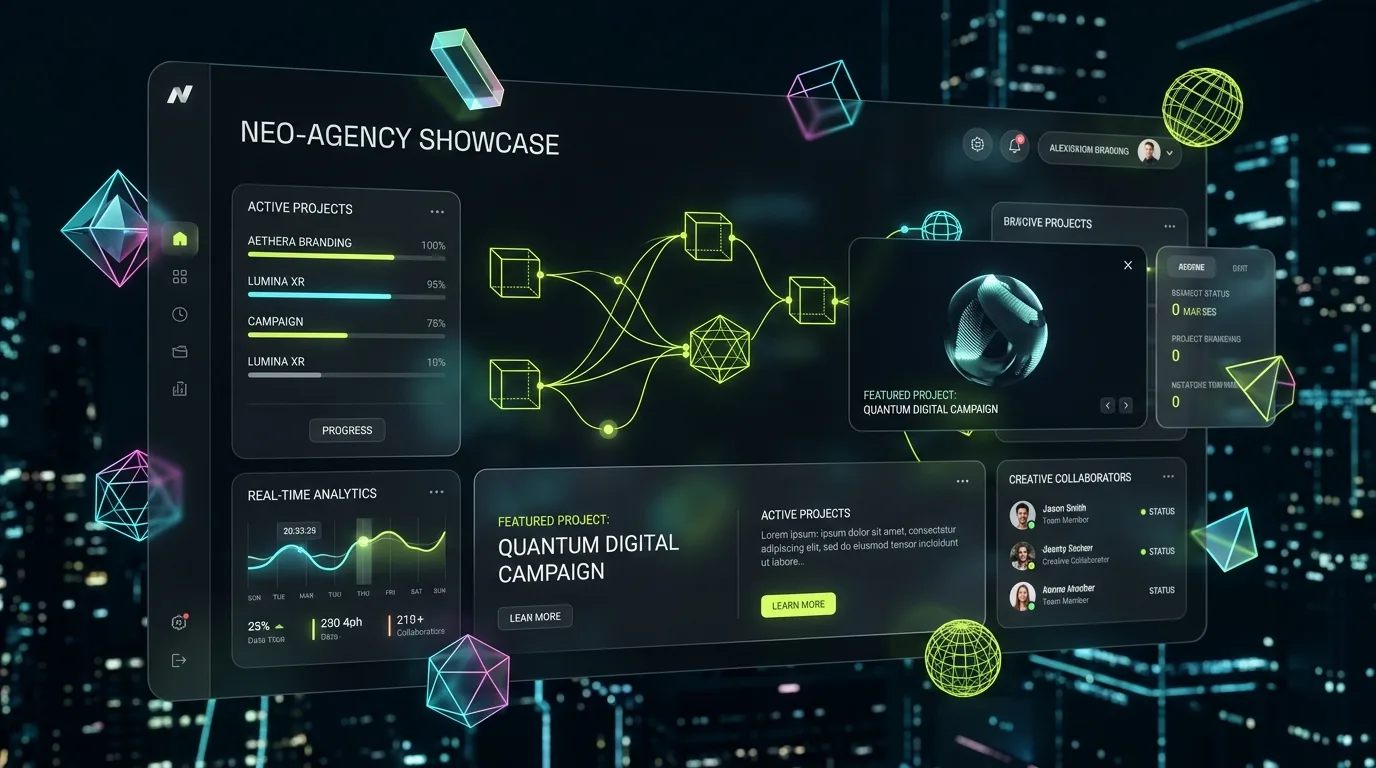
Web Application Development &
Custom SaaS Engineering

Custom Web Applications for
Real Business Workflows

Modern businesses operate on specialized workflows that generic off-the-shelf software cannot adequately support. When off-the-shelf platforms force your team into inefficient manual workarounds or impose rigid data boundaries, bespoke web application development provides tailored software infrastructure designed around your operational requirements.

While our custom web development practice specializes in brand flagships and marketing platforms, our web application engineering practice focuses on authenticated client portals, multi-tenant SaaS products, and high-density analytical dashboards. Every application is built with strict TypeScript type-safety, responsive React component systems, and scalable relational data models engineered for security, tenant isolation, and sub-second execution.

Explore Pixza AI Studio Case Study → Explore NextSchool ERP Case Study →
Next.js & React TypeScript PostgreSQL Role-Based Access (RBAC) API Integrations Client Portals

Client Portals & Authenticated Systems

Secure client-facing web applications where customers manage their accounts, review project milestones, submit confidential documents, and access personalized assets. Built with multi-factor authentication, granular data isolation, and responsive layouts tailored to both desktop and mobile devices.

Interactive Dashboards & Analytics Surfaces

High-density data visualization interfaces that convert complex operational metrics into actionable insights. We implement client-side caching, virtualized data tables, interactive charting, and real-time event updates to deliver responsive performance even under large datasets.

Internal Operations Tools & Workflow Utilities

Custom administrative consoles and operations platforms designed to replace fragmented spreadsheets. These systems automate internal approvals, record audits, and dispatch tasks, with optional integration into AI automation pipelines for intelligent data routing.

SaaS Product Interfaces & Multi-Tenant Software

Frontend and backend engineering for software-as-a-service products. We engineer multi-tenant workspaces, tiered permission models, user onboarding journeys, and automated billing management via payment gateways, providing a foundation for scalable digital products.
Pixza
AI · Creative SaaS Platform

Pixza

Flagship edge-native generative AI studio featuring multi-provider model orchestration, zero-downtime token rotation, and node-based visual Flow Mode.

Kova
AI · Visual Canvas Builder

Kova

AI website builder with an interactive visual canvas, combining prompt-driven section synthesis with real-time drag-and-drop layout manipulation.

View Case Study → Coming Soon
NextSchool ERP
Cloud ERP · Multi-Tenant

NextSchool ERP

Enterprise cloud school management ERP architected with granular role-based access control (RBAC), academic timetables, and finance modules.

NursePass
Healthcare LMS · German Certification

NursePass

Professional learning platform supporting international nurses through German licensing exams (Kenntnisprüfung & Anpassungslehrgang).

LMS Mobility Ecosystem
Multi-Role Mobile Ecosystem

Multi-Role LMS & School Mobility

Cross-platform Flutter mobile ecosystem combining Teacher/Staff workflows, Student/Parent academic portals, and real-time bus GPS tracking.

View Case Study → Enterprise Build

Type-Safe Full-Stack Contracts

We leverage TypeScript end-to-end across database schemas, API controllers, and client component props. Strongly typed interfaces catch data mismatches during compilation, prevent runtime anomalies, and serve as reliable living documentation for your engineering team.

State Management & Real-Time Reactivity

Complex web applications require disciplined state management. We structure client state using modern React patterns, optimistic UI updates for instantaneous user feedback, and resilient WebSocket or server-sent event connections for real-time notification streams. Read our technical breakdown on Next.js State Management & API Boundaries.

Relational Data Modeling & Query Optimization

We design relational schemas in PostgreSQL with carefully indexed foreign keys, connection pooling, and transactional integrity. Queries are tuned to minimize latency, avoiding N+1 anomalies and ensuring predictable response times as database volume expands.

Component-Driven Design Systems & Maintainability

Every application is built upon a modular component library. Reusable form controls, modal dialogs, and navigation frameworks guarantee visual consistency, streamline feature development, and simplify long-term maintenance. For architectural separation between server-rendered data containers and interactive controls, explore our guide on Next.js Server vs Client Components.

REST, REST APIs & Webhook Orchestration

We design resilient API endpoints conforming to REST and REST APIs conventions. Outgoing and incoming webhooks are validated using cryptographic signatures, replay-attack prevention, and exponential backoff retry queues to maintain data synchronization.

Authentication, Identity & Role-Based Access Control (RBAC)

Security begins with identity. We engineer role-based permission matrices that restrict actions based on user tier, organization membership, and resource ownership. Support for OAuth2 providers, Google Workspace, and enterprise Single Sign-On (SSO) can be integrated as needed.

Third-Party Gateway & Tool Connectors

We integrate web applications with essential commercial services, including payment gateways payment gateways, DocuSign document signing, SendGrid transactional emails, and cloud hosting S3 encrypted asset storage. For e-commerce workflows requiring custom application layers, we coordinate with Shopify development APIs.

Automated Data Pipelines & Background Processing

Long-running tasks such as report generation, bulk data imports, and document conversions are offloaded to background worker queues. This keeps application frontends responsive while asynchronous jobs process reliably in the background.

OWASP Application Security Baseline

Every application build incorporates defenses against common vulnerabilities outlined in the OWASP Top 10: parameterized SQL queries to prevent injection, contextual output encoding against cross-site scripting (XSS), and strict Content Security Policies (CSP).

Session Hygiene & Token Security

User sessions are managed using encrypted, HTTP-only, SameSite cookies to protect tokens from client-side interception. Idle session timeouts and active token revocation protect user accounts across devices.

Data Encryption & Multi-Tenant Isolation

Sensitive customer records are encrypted at rest using industry-standard AES-256 algorithms and in transit via TLS 1.3. In multi-tenant environments, row-level security (RLS) policies enforce logical data separation across client organizations.

Audit Logging & Error Boundary Resilience

Critical operations such as privilege escalation, billing alterations, and data deletion are captured in tamper-evident audit logs. Client-side React error boundaries prevent localized UI failures from crashing the entire application session.

01. Workflow Discovery & System Specification

We begin by mapping your user personas, operational workflows, and data relationships. We document functional specifications, define entity-relationship diagrams, and establish architectural boundaries before writing code.

02. Data Modeling & Interactive Prototyping

We create strongly typed database schemas and develop interactive wireframes for critical user journeys. This step validates usability, form layouts, and permission boundaries early in the design cycle.

03. Milestone-Driven Full-Stack Implementation

Development proceeds across structured sprints. We implement frontend component systems, backend controllers, and third-party integrations, providing access to staging environments for continuous stakeholder feedback.

04. Automated Testing & Security Verification

Before production deployment, we conduct automated unit and integration tests, verify permission boundaries across user tiers, profile database queries, and review endpoints against security baselines.

05. Production Deployment & Continuous Evolution

We configure production infrastructure, establish CI/CD automated deployment pipelines, and conduct smoke testing. Following launch, we deliver documented source repositories and offer retainer agreements for ongoing feature expansion.

Data-Driven User Workflows vs Static Content

If your users need to manipulate records, execute calculations, upload assets, or trigger real-time actions, a traditional CMS website quickly becomes cumbersome. Web applications are engineered around interactive data transactions rather than static page views.

Authenticated Personalization vs Generic Experience

Marketing websites present identical content to every visitor. In contrast, web applications maintain authenticated sessions that personalize data, display tailored dashboards, and enforce role-based access rules.

Deep Business Logic vs CMS Plugin Chains

Attempting to build complex operational software by chaining CMS plugins often leads to fragile architectures and high maintenance costs. Bespoke web applications provide maintainable, tailored software without third-party plugin debt.

Long-Term TCO & System Scalability

While initial investment in custom web application development is higher than a templated site, custom code eliminates recurring per-user software license fees, provides proprietary intellectual property, and scales predictably with your organization. Read our essay on when ambitious brands need to graduate to custom code.

// 01 What distinguishes a web application from a standard custom website?

A standard website primarily presents content and information to visitors, whereas a web application delivers interactive functionality, authenticated user sessions, persistent database transactions, complex business logic, and real-time state management across private user accounts or administrative portals.

// 02 What technology stack do you use for custom web application development?

We build web applications using Next.js, React, and TypeScript on the frontend paired with Node.js API endpoints, relational databases such as PostgreSQL, and database caching for caching. Infrastructure is typically deployed across Vercel, cloud hosting, or edge routing depending on workload demands.

// 03 How do you handle user authentication and access permissions?

We implement industry-standard authentication systems with secure session tokens, encrypted HTTP-only cookies, and granular role-based access control (RBAC). This ensures users access only their authorized accounts, documents, and administrative actions.

// 04 Can you integrate our web application with external APIs and legacy databases?

Yes. We regularly connect custom web applications to external REST and REST APIs APIs, legacy SQL or ERP databases, payment processors such as payment gateways, and automated webhook pipelines to synchronize data across disparate business systems.

// 05 Do you build multi-tenant SaaS application frontends?

Yes. We engineer SaaS application frontends featuring role-based workspace isolation, subscription billing integrations, user onboarding flows, and responsive management dashboards designed for high daily user engagement.

// 06 Who retains ownership of the web application source code?

You retain 100% intellectual property ownership of the source code, architecture documentation, and design assets upon milestone settlement. We deliver clean, modular Git repositories with no vendor lock-in or proprietary runtime dependencies.
" engineered for operational scale "
SCALABLE ARCHITECTURE

BUILD A CUSTOM WEB APPLICATION
THAT EMPOWERS YOUR
BUSINESS

ENGINEERED FOR SCALE